

Kisspeptin-10
Also known as: Kp-10 · Metastin
The upstream trigger of the entire reproductive axis. Early human trials hint at uses for HSDD and hypothalamic amenorrhea; nothing is approved.
Overview
Kisspeptin sits one rung above GnRH on the reproductive ladder. When kisspeptin-expressing neurons in the hypothalamus fire, they tell GnRH neurons to release GnRH, which tells the pituitary to release LH and FSH, which tells the gonads to make sex steroids. Kisspeptin-10 is the truncated active fragment used in research. Imperial College London's group under Waljit Dhillo has run small Phase 1 and 2 studies showing kisspeptin can restart pulsatile GnRH release in women with hypothalamic amenorrhea and boost sexual responsiveness in men and women with low desire. The human evidence base is small, short, and not yet anywhere close to a labelled indication.[1]
Evidence quality
The Dhillo group at Imperial College London has run the most clinically interesting human work. Restored ovulatory cycles in hypothalamic amenorrhea, plus a small HSDD trial in women showing increased limbic activation on functional MRI. Sample sizes are in the dozens, not the thousands. There is no approved indication anywhere.
Benefits & timeline
Benefits
- Restores pulsatile GnRH signalling in functional hypothalamic amenorrhea (the most replicated finding)
- Modest libido and sexual-response increase in early HSDD trials in both sexes
- Acts above GnRH. Useful when the downstream axis is intact but the upstream signal has gone quiet
- No suppression of endogenous production at typical research doses. It's a stimulator, not a replacement
Timeline
Single dose
Acute LH and FSH rise within 30 to 60 minutes; subjective libido change is variable.
Week 2 to 3
Hormonal labs (LH, FSH, oestradiol or testosterone) shift in responders. Non-responders look largely unchanged.
Week 4 to 6
Most users have a clear sense by here of whether they're in the responder bucket.
Off-cycle
Built-in 4 weeks off after every 6 to 8 week run; the hypothalamus needs the pause to keep its pulsatility honest.
Dosage protocols
Advanced
500 mcg
once daily
Beginner
100 mcg
once daily
Standard
250 mcg
once daily
Titration & adjustment
Start at 100 mcg subcutaneously once daily. After 2 weeks escalate to 250 mcg daily if libido/hormone improvements are not yet measurable. Maximum 500 mcg daily. Cycle off for 4 weeks every 8 weeks.
Injection timing

Once daily, time of day flexible. Pre-bed dosing may align with the natural overnight LH surge.
Side effects & contraindications

- mildInjection-site soreness.
- mildMild headache.
- mildTransient hot-flush sensation in the first hour after dosing. The upstream LH surge has its own vasomotor footprint.
- moderateLimited human safety data beyond a few months of dosing. The mechanism is physiological, but 'used inside the body for billions of years' isn't the same as 'characterised at the doses people are injecting'.
Contraindications
- Pregnancy
- Active hormone-sensitive cancer (breast, prostate). Restoring LH/FSH pulses is exactly what you don't want in this context
- Children and adolescents. The HPG axis is not a place for unsupervised experimentation
- Concurrent GnRH-agonist therapy for endometriosis or prostate cancer. The two work against each other
Reconstitution & injection
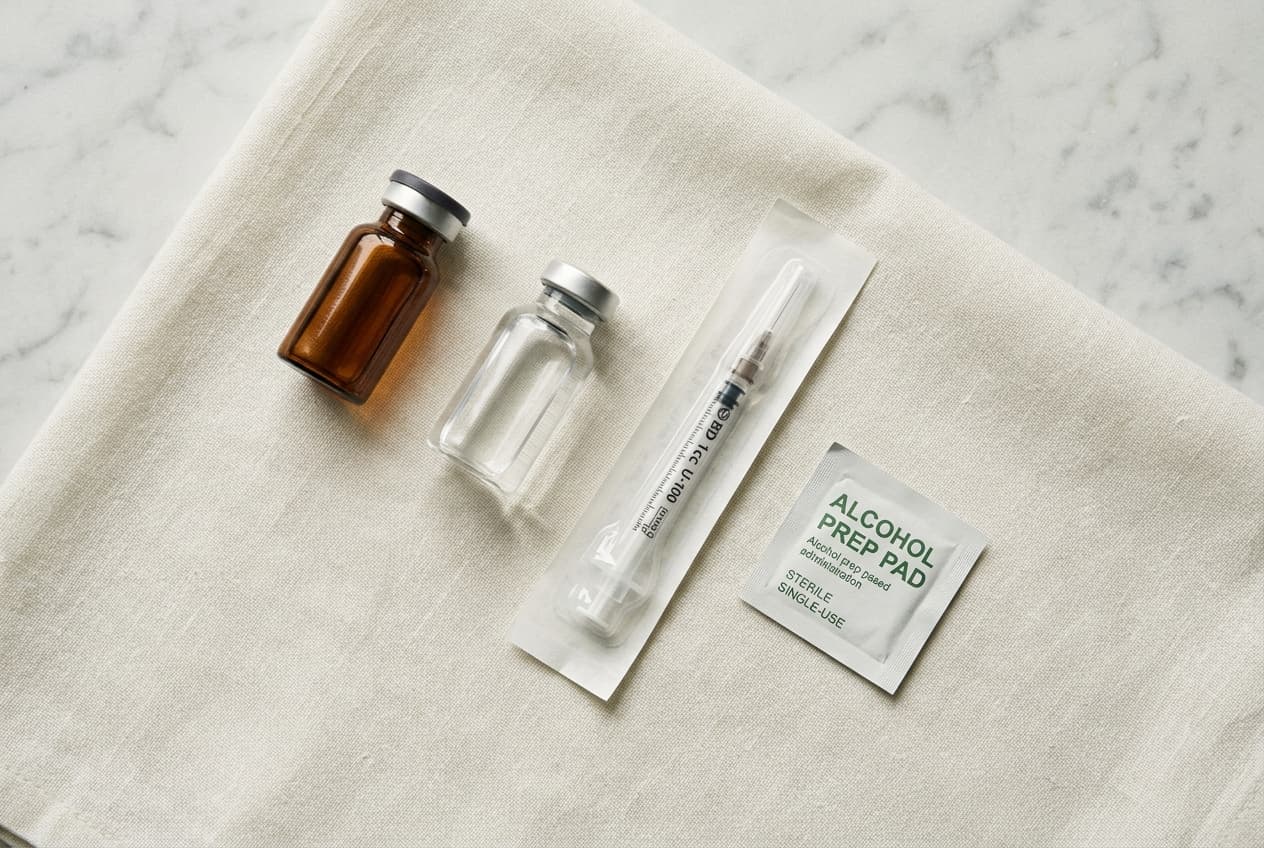
A 5 mg vial reconstituted with 2 ml bacteriostatic water gives 2.5 mg/ml. A 250 mcg dose is 0.1 ml, which is 10 units on a U-100 insulin syringe. Subcutaneous in the abdomen or thigh, once daily. Pre-bed dosing aligns with the natural overnight LH surge, but the half-life is short and time-of-day is not the variable that determines response.
Open calculator pre-filledStorage after reconstitution
Refrigerate at 2 to 8 °C after reconstitution. Do not freeze. Light-protected. 28 to 30 days of stability at fridge temperature in BAC water.
Cost & sourcing red flags
Typical price range: Research-grade 10 mg vials run $80-160; 5 mg vials $50-110. A community-style protocol (100-300 mcg subcutaneous once or twice daily) burns roughly one 10 mg vial per 4-8 weeks, so material cost is $10-40 per month. Clinical-trial-grade kisspeptin used in published HPG-axis studies is not commercially available outside trial sites.
Red flags
- Vials labelled simply 'kisspeptin' without specifying the fragment. Kisspeptin-10, kisspeptin-54 and the parent KISS1 metapeptide have different half-lives and clearance; protocols are not interchangeable.
- 10 mg vials under $40. Kisspeptin-10 is a decapeptide with disulfide-bond complexity in the parent that vendors sometimes shortcut; bargain pricing often correlates with incomplete folding or truncated sequence.
- No batch-specific HPLC and mass-spec showing the expected 1302 Da mass. The C-terminal amidation is critical for receptor binding; non-amidated material is functionally inactive and would not be caught by a generic 'purity %' report.
- Vendors marketing kisspeptin-10 for daily long-term TRT-replacement use in men. Clinical studies show pronounced LH desensitisation after repeated boluses within days; the receptor downregulates fast and chronic dosing schedules are not supported by the trial pharmacology.
- Sources pitching kisspeptin to women trying to conceive without medical oversight. The published clinical work in hypothalamic amenorrhoea uses pulsatile pump delivery with hormonal monitoring; self-injection without LH/FSH tracking is unlikely to reproduce trial outcomes and can mask underlying causes of amenorrhoea.
Pricing rots fast and varies by region and supplier. We list no vendors.
Common mistakes
Treating it like HCG.
Better approach: HCG mimics LH at the gonad. Kisspeptin acts on the hypothalamus. They sit on opposite ends of the axis, and substituting one for the other gets the physiology wrong. Pick the level of the axis you're actually trying to restore.
Expecting a libido drug.
Better approach: The libido signal in the trials is modest. If acute desire is your only target, PT-141 is more reliable. Kisspeptin is the better pick when the goal is restoring the underlying hormonal architecture, not bypassing it.
Running it continuously without off-cycles.
Better approach: Continuous high exposure to kisspeptin desensitises kisspeptin receptors and paradoxically suppresses GnRH release. The same trick that GnRH analogues exploit in prostate-cancer therapy. Cycle 6 to 8 weeks on, 4 weeks off.
Skipping bloodwork.
Better approach: This is one of the peptides where you can actually measure whether it's working. LH, FSH, oestradiol or testosterone before starting and at week 4 tell you in numbers whether you're a responder. Don't fly blind on a hormone axis.
Real-world tips
- Reconstituted vials are stable in the fridge for about 2 weeks. Past that, expect some potency loss.
- Pair it with a labs panel. The whole point of using this peptide is to confirm the axis is moving, not to take it on faith.
- If you're a woman tracking cycle restoration, chart basal body temperature alongside the labs. The biphasic shift is the cleanest signal that ovulation has returned.
- Don't combine with TRT in men trying to preserve fertility. The exogenous testosterone shuts the axis down upstream of where kisspeptin is trying to push it. The signals cancel.
- Build in the 4-week off period before you start. People who forget often find their response curve has flattened by week 10.
What users report
Sparse data well. Most self-experimentation comes from male biohackers experimenting with libido and HPG-axis effects; female fertility use almost always goes through a clinical-trial site rather than forums.
Onset: Men describe a felt increase in libido and morning erections within 30-90 minutes of a single 100-200 mcg subcutaneous dose, peaking around 1-2 hours and fading by 4-6 hours, consistent with the published 30-minute LH-rise window.
Common reports
- Acute libido bump and increased erection frequency for several hours after dosing, the single most reported effect among male users.
- Mild flushing and warmth in the face within 15-30 minutes of subcutaneous injection.
- Headache and lightheadedness in the first 1-2 doses, usually resolving by the third dose.
- Loss of effect within 5-10 days of daily dosing, consistent with the GnRH-receptor desensitisation seen in clinical pulsatile-vs-continuous comparisons; users who pulse (every 3-4 days) report more durable response.
- Injection-site redness and itch more often than with shorter peptides; users attribute this to research-grade material quality rather than the molecule itself.
Where reports diverge from theory: The published trial literature centres on women with hypothalamic amenorrhoea and on cycle-restart fertility outcomes, with pulsatile infusion as the dominant protocol. Forum use is overwhelmingly male, single-shot, libido-focused, and based on extrapolation from acute LH-rise studies in healthy male volunteers. Whether the libido effect outlasts the LH pulse, and whether repeated daily dosing produces durable testosterone elevation rather than rapid tachyphylaxis, are unresolved questions in humans. Reports of long-term testosterone gains from self-dosed kisspeptin should be read sceptically.
When something else is the better tool
HCG / gonadorelin
Use instead when: You want to keep testicular function during TRT or trigger ovulation. They act at the gonad and pituitary respectively. Both downstream of kisspeptin and with much more clinical track record.
PT-141
Use instead when: Acute libido is the only goal and the underlying hormone panel is fine. Kisspeptin is the wrong tool when desire is the only complaint.
Pulsatile GnRH (clinical only)
Use instead when: Hypothalamic amenorrhea is the diagnosis and you have access to a specialist centre. The track record is longer and the protocols are better defined.
Based on 1 peer-reviewed study
- Does it suppress my own production?
- At physiological pulsatile doses, no. It stimulates. At continuous high exposure, paradoxically yes. The pulse cadence matters as much as the dose.
- Can men use it for testosterone?
- Early data is promising but not enough to recommend it as a TRT alternative. If your goal is raising T and you have hypogonadism, treat the diagnosis with conventional therapy.
- What labs should I track?
- LH, FSH, oestradiol (women) or testosterone (men), and SHBG. Baseline and week 4. If nothing has moved by week 4, more weeks rarely change the picture.
- How does it compare to gonadorelin?
- Gonadorelin is GnRH itself. One rung lower. Kisspeptin is one rung higher. Choose by which part of the axis you suspect is dysregulated.
- Is there long-term safety data?
- No. Trials so far have run weeks to a few months. The mechanism is endogenous, which is reassuring, but 'endogenous' and 'safe at exogenous doses' are not the same thing.
Last updated:
Related peptides
Other compounds in this category
- PT-141Melanocortin-receptor agonist that works on desire in the brain, not blood flow in the pelvis. FDA-approved as Vyleesi for premenopausal HSDD.
- HCGHuman chorionic gonadotropin. A placental hormone that mimics LH and tells the testes to keep making testosterone and sperm. The most clinically established HPG-axis tool in this catalogue.
- GonadorelinSynthetic GnRH. The pulsatile signal from the hypothalamus that tells the pituitary to release LH and FSH. The upstream lever in the HPG axis.
- OxytocinThe body's bonding hormone, repurposed as intranasal spray for social and intimacy effects. The hype outpaces the trial data.
- HMGHuman menopausal gonadotropin. Extracted from postmenopausal urine and containing both LH and FSH activity. The FSH supply that HCG can't provide.