

HMG
Also known as: Human Menopausal Gonadotropin · Menotropin
Human menopausal gonadotropin. Extracted from postmenopausal urine and containing both LH and FSH activity. The FSH supply that HCG can't provide.
Overview
HMG is the older sibling of recombinant FSH, originally purified from the urine of postmenopausal women (where LH and FSH rise because the ovaries have stopped responding). Each vial contains roughly equal LH and FSH activity, which makes it functionally distinct from HCG (LH-only) and from rFSH (FSH-only). In male fertility work, HMG is almost always added to HCG rather than used alone. HCG gives you the Leydig-cell signal, HMG gives you the Sertoli-cell support that drives mature spermatogenesis. The catch is patience: full sperm-parameter recovery on HCG + HMG takes 10 to 24 weeks, not 4, and escalating earlier than that mostly costs money rather than buying speed.[1]
Evidence quality
HMG is approved for assisted reproduction and for male infertility associated with hypogonadotropic hypogonadism. The male-fertility use case is supported by a long literature base, including the 2009 review on HMG in male infertility (Liu et al.) and decades of WHO-sponsored work. Approved status reflects the fertility indication specifically. Using HMG for testosterone optimisation or HPG-axis recovery outside fertility goals is off-label.
Benefits & timeline
Benefits
- Supplies the FSH signal needed for full spermatogenesis. Sertoli-cell support that HCG alone cannot provide
- Used adjunctively in male infertility when HCG monotherapy stalls at low sperm counts
- Has decades of clinical use in IVF protocols, so the pharmacology and safety envelope are well characterised
- Often the difference between a partially recovered HPG axis and a fully fertile one in long-suppressed users
Timeline
Week 1 to 2
Nothing perceptible. Spermatogenesis is a 70-day cycle. Early sperm parameters do not reflect the new signal yet.
Week 4 to 6
FSH-driven Sertoli-cell activity ramping. Still nothing to see on a semen analysis.
Week 12
First semen analysis worth running. Counts may have moved or may still be climbing.
Week 16 to 24
Mature sperm produced under the new FSH signal reach the ejaculate. This is the honest first read on whether the protocol is working.
Off-cycle
4 weeks off after a 12 to 24-week course is conventional, but in fertility protocols continuous dosing through to conception is more common.
Dosage protocols
Advanced
150 iu
three times weekly
Used adjunctively with HCG for fertility restoration.
Beginner
75 iu
twice weekly
Standard
75 iu
three times weekly
Titration & adjustment
Used with HCG, not alone. Start at 75 IU twice weekly. If sperm parameters do not improve at 12 weeks, escalate to 75 IU three times weekly, then to 150 IU three times weekly. Full spermatogenesis recovery takes 10 to 24 weeks. Be patient before escalating further.
Injection timing

2 to 3× weekly, same time-of-day each dose. Co-time with HCG if pairing. The two work synergistically and combining injection schedules is more convenient.
Side effects & contraindications

- mildInjection-site reaction. Slight redness or bump for a day.
- mildMild headache or fatigue in the first weeks, often resolving on its own.
- moderateGynecomastia risk if combined HCG + HMG drives estradiol up. Lab monitoring at 6 and 12 weeks is non-negotiable.
- moderateAllergic reactions to the urinary-derived protein content. Rare with modern purification, but still listed on prescribing labels.
Contraindications
- Hormone-sensitive cancers (prostate, breast). The same reasoning as HCG: stimulating gonadal output is the wrong direction
- Untreated thyroid or adrenal dysfunction. These systems interact, and pushing gonadal output on top of an unstable axis tends to be messy
- Known hypersensitivity to urinary-derived gonadotropins
- Pregnancy (not an indication for men; for women only under specialist supervision)
Reconstitution & injection
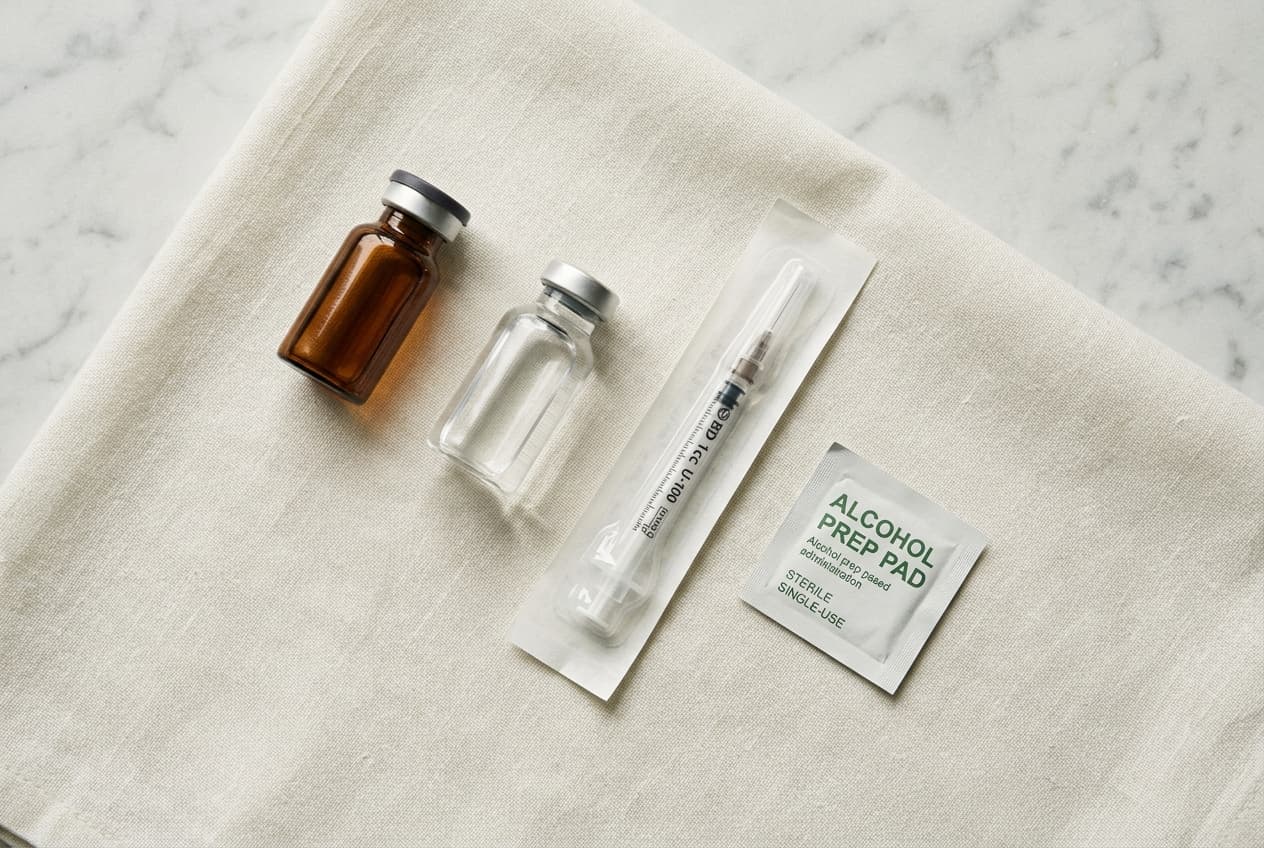
HMG comes lyophilised, typically 75 IU per vial. Reconstitute with 1 ml bacteriostatic water for 75 IU per ml. A 75 IU dose is the full ml, which is 100 units on a U-100 insulin syringe (use a longer-barrel insulin syringe or split into two 50-unit injections). Subcutaneous into abdomen or thigh. Refrigerate after reconstitution; use within 28 days. Like HCG, swirl gently. Don't shake.
Open calculator pre-filledStorage after reconstitution
Refrigerate at 2 to 8 °C after reconstitution. Do not freeze. Light-protected. Like HCG, hMG is a glycoprotein and thermolabile. 28 to 30 days at fridge temperature is the practical window. The dose is small (75 IU per injection typically), so reconstitution volume should match the dosing cadence; if you only inject 2 to 3 times per week, a smaller mix volume avoids carrying old solution into week 5.
Cost & sourcing red flags
Typical price range: Pharmaceutical HMG (Menopur, Merional, Pergoveris) costs $75 to 130 per 75 IU ampoule at US specialty pharmacies, with a typical male-fertility protocol burning $1,500 to 3,000 per month at 150 IU three times weekly. Compounded HMG via fertility-focused US pharmacies runs $40 to 80 per ampoule. Research-grade 'HMG' powders sold online for $25 to 60 per 75 IU vial are unverified and usually a mix of unknown FSH/LH ratios.
Red flags
- Research-grade 'HMG' vials priced under $40 per 75 IU. Genuine HMG is purified from postmenopausal women's urine and the production cost alone exceeds that price; grey-market 'HMG' is typically recombinant FSH cut with a small dose of HCG to mimic the LH activity, which is not the same molecule.
- No declared FSH:LH ratio on the label. Real HMG carries a documented 1:1 bioactivity ratio; an unlabelled vial cannot be used reliably in a fertility-restart protocol where the ratio drives the outcome.
- Single-vial pricing far below the per-ampoule pricing of any IVF specialty pharmacy in the same country. HMG has a thin global supply chain and large arbitrage is implausible.
- Sellers conflating HMG with menotropin, urofollitropin, or recombinant FSH in their product copy. These are distinct molecules with distinct ratios; a vendor who blurs them is not handling the source material with the precision the protocol requires.
- Vials reconstituted by the seller before shipping. HMG loses gonadotropin activity within hours of reconstitution at room temperature; reputable supply ships lyophilised.
Pricing rots fast and varies by region and supplier. We list no vendors.
Common mistakes
Running HMG alone for fertility.
Better approach: HMG contains LH activity, but the LH dose per ampoule is small relative to what HCG delivers. The proven protocol is HCG (LH signal) + HMG (FSH signal). Using HMG monotherapy in men is rarely effective and rarely indicated.
Escalating dose at week 6 because counts haven't moved.
Better approach: Spermatogenesis takes 10 to 24 weeks. The signal you added today doesn't show up in semen until those cells have matured through the cycle. Hold the dose at 75 IU two or three times weekly until at least week 12 before deciding whether to escalate.
Stopping HMG the day a partner conceives.
Better approach: If the goal is more than one child, or if sperm parameters are still climbing, stopping abruptly often resets the protocol. Many fertility specialists taper rather than stop cold, or maintain HCG monotherapy after HMG is withdrawn.
Ignoring estradiol because 'HMG isn't HCG.'
Better approach: HMG's LH activity also drives Leydig cells, and the combined HCG + HMG protocol stacks two LH signals. Estradiol can climb faster than expected. Check at 6 and 12 weeks.
Real-world tips
- Schedule a semen analysis at baseline, 12 weeks, and 24 weeks. Anything more frequent burns money on data that won't have changed.
- Co-time HMG and HCG injections. Same syringe is fine if you reconstitute the HCG into the HMG vial. The two are physically compatible.
- Refrigerate the unopened vials; reconstituted vials degrade faster than HCG so use within 28 days rather than 30+.
- If you're paying out of pocket, recombinant FSH (Gonal-F, Follistim) is often cheaper per IU than HMG and supplies cleaner FSH activity without the LH component. Useful if you're already running adequate HCG.
- Spermatogenesis recovery from long-term steroid use can take 12 to 24 months. The data is reassuring that most men recover, but the patience required is real.
What users report
Aggregated from r/Steroids PCT threads, ExcelMale fertility forums, and r/maleinfertility. Not clinical data.
Onset: Spermatogenic response lags weeks behind the LH-like effect on testes; users on combined HCG + HMG describe testicular volume recovery in weeks 4 to 8 and the first detectable change in semen parameters around week 10 to 12, with full response taking 6 to 9 months.
Common reports
- Testicular volume gains beyond what HCG alone produces, attributed to the FSH-driven Sertoli cell stimulation. Users running HCG+HMG stacks report fuller, denser testicles versus HCG monotherapy at month 3.
- Injection-site stinging and small wheals more often than with HCG, particularly with Menopur. Bringing the reconstituted ampoule to room temperature and injecting slowly reduces the burn.
- Mild fatigue in the first 1 to 2 weeks of adding HMG to an HCG protocol; resolves as the HPTA recalibrates.
- Cost shock once users price out a 6-month protocol. The financial side effect is the most consistently reported one on the male-infertility subreddits.
- Skin acne and oily skin in the first month, mirroring rising androgen production from the dual gonadotropin stimulation.
- Disappointment at slow semen-parameter response. Forum reports often describe weeks 6 to 10 as the demoralising plateau, with the actual sperm count rebound landing month 3+.
Where reports diverge from theory: Bodybuilding forums sometimes recommend HMG as a generic FSH source to be used short-term during PCT. The fertility-restart literature treats HMG as a 3 to 9 month commitment because spermatogenesis itself takes 72 days per cycle, and SSP recovery in men coming off long androgen exposure averages 5 to 6 months. Short 4 to 6 week 'HMG add-ons' that forums describe almost never produce the semen response the user expects, which is a timing-versus-biology gap rather than a product gap.
When something else is the better tool
Recombinant FSH (Gonal-F, Follistim)
Use instead when: Pure FSH supply is what you want, without the additional LH activity. Cleaner pharmacology, often cheaper per IU. The right pick when HCG is already supplying enough LH signal.
HCG monotherapy
Use instead when: Spermatogenesis is recovering steadily on HCG alone. Common in men with shorter suppression histories. Adding HMG buys little when HCG is doing the job.
SERM-based protocol (clomiphene/enclomiphene)
Use instead when: The pituitary is suppressed but functional, and you want endogenous LH/FSH output instead of exogenous supply. Oral, lower cost, and often the first-line move in younger men.
Based on 1 peer-reviewed study
- Can HMG be used alone for low testosterone?
- Technically yes, but it's not the efficient tool. HMG's LH activity per vial is modest and the FSH component is wasted if fertility isn't the goal. For TRT-adjunct testicular maintenance, HCG is the cleaner pick.
- How long until sperm counts recover?
- 10 to 24 weeks is the realistic window. Shorter suppression histories recover faster; men coming off years of high-dose anabolic steroids can take a year or more. Patience and lab monitoring beat dose escalation.
- Is the urinary-derived source a concern?
- Modern HMG is highly purified and the urinary protein contamination that caused issues in older preparations is largely gone. Allergic reactions are rare. If you want zero urinary-derived material, recombinant FSH is the alternative.
- Do I need HMG if I'm just doing PCT?
- Usually not. Short-cycle PCT after a moderate steroid course is well-served by HCG plus a SERM. HMG enters the picture when fertility is the explicit goal and HCG alone is insufficient.
- Can I mix HMG and HCG in one syringe?
- Yes. Reconstitute the HCG into the HMG vial. The two are compatible and this saves an injection. Match the volumes so you can dose accurately.
Last updated:
Related peptides
Other compounds in this category
- PT-141Melanocortin-receptor agonist that works on desire in the brain, not blood flow in the pelvis. FDA-approved as Vyleesi for premenopausal HSDD.
- HCGHuman chorionic gonadotropin. A placental hormone that mimics LH and tells the testes to keep making testosterone and sperm. The most clinically established HPG-axis tool in this catalogue.
- GonadorelinSynthetic GnRH. The pulsatile signal from the hypothalamus that tells the pituitary to release LH and FSH. The upstream lever in the HPG axis.
- OxytocinThe body's bonding hormone, repurposed as intranasal spray for social and intimacy effects. The hype outpaces the trial data.
- Kisspeptin-10The upstream trigger of the entire reproductive axis. Early human trials hint at uses for HSDD and hypothalamic amenorrhea; nothing is approved.