

Oxytocin
Also known as: Oxytocin Acetate
The body's bonding hormone, repurposed as intranasal spray for social and intimacy effects. The hype outpaces the trial data.
Overview
Oxytocin is the nine-amino-acid peptide your hypothalamus releases during childbirth, breastfeeding, orgasm, and any social moment that feels safe. The intranasal form has been studied for autism, PTSD, couple's therapy, social anxiety. And the early excitement has not been reproduced reliably at scale. Effect sizes shrink when trials get bigger. That doesn't make it useless: some users report a real shift in how connected or settled they feel after a dose. The gap between 'this molecule does important things in the body' and 'a spray in the nose reliably reproduces those things' is wider than the wellness market admits.[1]
Evidence quality
Many small trials, several large null replications. The original autism-spectrum and 'trust hormone' studies have failed to replicate at the magnitude they originally claimed. Intranasal oxytocin for HSDD and partner bonding has small RCT support but nothing close to regulatory-grade. The IV form is approved for obstetric use; the spray is research-grade only.
Benefits & timeline
Benefits
- Subjective sense of closeness or trust, especially around intimate moments or stressful social ones
- Can blunt the cortisol response to a stressful conversation in some users
- May enhance the emotional component of orgasm. Most consistently reported anecdotally
- No tolerance build-up at typical intermittent dosing
Timeline
20 to 40 min post-dose
Onset of any subjective effect. Warmth, openness, or simply nothing.
1 to 2 hours
Peak window.
Same evening
Effect fades; no hangover.
After 4 to 6 weeks of regular use
Some users report diminishing returns. Cycle off for a couple of weeks and the response usually resets.
Dosage protocols
Advanced
200 mcg
twice daily
Beginner
50 mcg
as needed
Standard
100 mcg
twice daily
Titration & adjustment
Start at 50 mcg intranasally once before social activity. After 1 week, you can use up to 100 mcg twice daily if regular use suits you. Tolerance develops with daily long-term use. Many users cycle on/off in 4-week phases.
Injection timing

Pre-social-event for context-specific use, OR 1× daily morning + 1× evening for routine use. Intranasal absorbs faster than subcutaneous.
Side effects & contraindications

- mildNasal irritation and a slightly stuffy feeling from intranasal use.
- mildMild headache.
- mildEmotional sensitivity. Some users feel more tearful or more reactive, not always pleasantly.
- moderateLimited long-term safety data outside of obstetric use. The intranasal cosmetic-wellness use is not what oxytocin was originally licensed for.
Contraindications
- Pregnancy. Risk of uterine contractions, especially in late pregnancy
- Severe hyponatraemia. Oxytocin causes water retention via vasopressin cross-activity
- Recent cardiac event
- Concurrent SSRIs with caution. Anecdotal reports of blunted effect
Reconstitution & injection
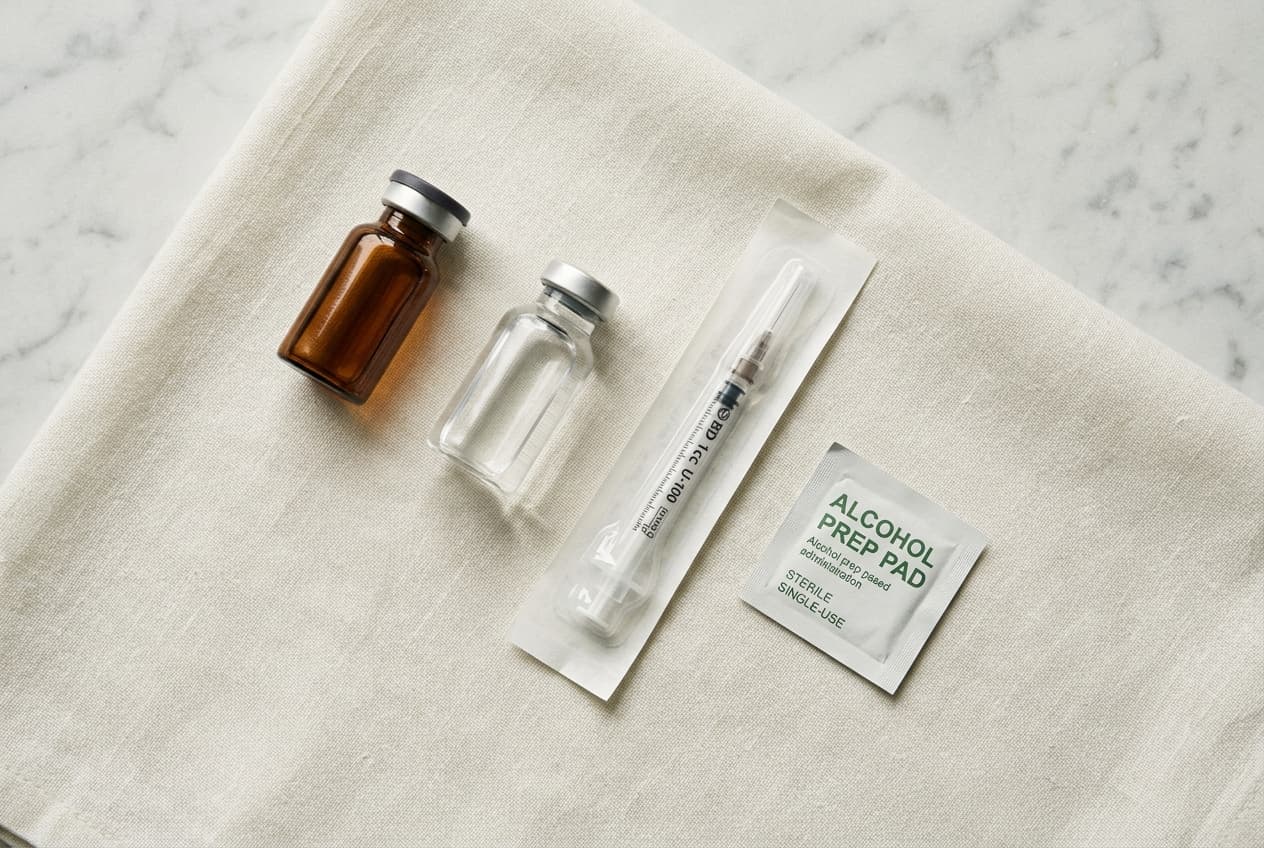
A 5 mg vial reconstituted with 5 ml bacteriostatic water gives 1 mg/ml. For intranasal use, transfer to a nasal spray bottle that delivers a measured 0.1 ml per actuation. That's 100 mcg per spray. A typical 'connection' dose is 1 to 2 sprays per nostril, dosed 20 to 30 minutes before the social or intimate moment. Subcutaneous use exists in the literature but is rare in practice. Intranasal is the convention because at least some peptide reaches the CNS via the olfactory route.
Open calculator pre-filledStorage after reconstitution
Refrigerate at 2 to 8 °C immediately after reconstitution. Do not freeze. Light-protected. Oxytocin is among the least stable peptides on this list. Realistic in-fridge potency is 14 to 21 days, with measurable degradation by day 14. Intranasal sprays prepared from oxytocin powder degrade fastest of all formulations because the pump exposes the solution to air with every use; mix smaller batches and replace every 2 weeks.
Cost & sourcing red flags
Typical price range: Compounded intranasal oxytocin from US compounding pharmacies (Empower, Harbor, Fusion, Kare): $150 to 270 per 10 mL bottle at 50 to 100 IU/mL, usually a 1 to 2 month supply at 24 to 40 IU per dose. Telehealth subscriptions bundle the consult plus refill at $80 to 150 per month. Research-grade lyophilised oxytocin acetate vials run $20 to 60 per 2 to 5 mg, but require buyer-compounded saline reconstitution.
Red flags
- Nasal sprays sold without a stated potency-loss-over-time profile. Independent LC-MS testing of one popular compounded spray showed 58% loss of labelled potency after 14 days at 22°C. A pharmacy that ships room-temperature with a 90-day beyond-use date is selling you mostly degraded peptide by week 3.
- Research-grade oxytocin acetate from peptide vendors at under $15 per 2 mg vial. Oxytocin is a small, well-characterised nonapeptide; the floor price for genuine product is around $20, and vials below that routinely assay short.
- Compounders using benzyl alcohol or chlorobutanol as preservative without flagging it. Both irritate nasal mucosa and cause the burning-on-spray complaint that gets blamed on the peptide itself.
- Telehealth services prescribing oxytocin nasal spray for 'autism' or 'attachment disorder' without disclosing that the Phase 3 SOARS-B trial in autism failed to beat placebo. The marketing is ahead of the evidence.
- Nasal spray bottles without a metered pump (just a squeeze bottle). Oxytocin dose-response is steep and inverted-U; uncontrolled dosing produces inconsistent effects users blame on the peptide.
Pricing rots fast and varies by region and supplier. We list no vendors.
Common mistakes
Expecting it to fix a relationship.
Better approach: It can soften the room; it can't change what's in the room. People who use it as a couples-therapy adjunct alongside actual conversation report the most consistent benefit. People who use it as a substitute for the conversation don't.
Daily dosing for general well-being.
Better approach: Receptor desensitisation is the most common reason people say 'it stopped working'. Pulse it for specific events (date nights, hard conversations, a high-stakes presentation) and the response stays intact.
Spraying it in the lower nostril.
Better approach: The olfactory absorption pathway is in the upper nasal cavity. Tilt your head back slightly, spray upward, and stay still for 30 seconds. Most of the dose otherwise drips down into the throat where it's destroyed.
Stacking it with sedatives or alcohol for a 'mellow' feeling.
Better approach: Oxytocin is not a sedative. The emotional softening can interact with depressants in unpredictable ways. Use it alone first to learn what your baseline response looks like.
Real-world tips
- Refrigerate after reconstitution. Oxytocin is fragile. Room-temperature storage costs you potency within a few days.
- Track whether you actually felt anything. The placebo response is real with this peptide, and users who keep notes often discover the effect is smaller than they remembered.
- Spray into a tissue first to prime the bottle if it's been sitting. The first actuation is often under-dose.
- Pair it with the situation you want to enhance. The effect is context-sensitive: a dose in front of a screen does less than a dose with another person.
- If you feel nothing on three separate doses, it's probably not for you. Some people are non-responders and pushing the dose doesn't help.
What users report
Aggregated from r/Peptides, r/Nootropics, and forum threads. Not clinical data.
Onset: Intranasal 24 to 40 IU: subjective social-warmth or anxiety-softening effect typically lands 15 to 30 minutes after dosing and tapers over 60 to 90 minutes.
Common reports
- A 'social context amplifier' description recurs constantly: users report that oxytocin makes existing positive interactions feel softer and warmer, but produces almost nothing when dosed alone at home.
- Reduced social hypervigilance and faster eye-contact comfort in group settings, dosed 20 to 30 minutes before the event.
- Mild headache and transient nasal stinging are the most common downsides, usually resolving within an hour.
- Couples using it pre-sex report a 'connectedness' shift rather than a libido boost; this is the consistent distinction made against PT-141 in side-by-side threads.
- Effect fade-out over weeks of daily use is widely reported. Most users settle into 2 to 3x weekly dosing rather than daily because daily dosing seems to blunt the response.
Where reports diverge from theory: Mechanistic literature frames oxytocin as a generalist prosocial neuropeptide, but real-world reports cluster heavily on the 'amplifier of existing context' interpretation, not a standalone mood lift. Users who dose oxytocin expecting an SSRI-style effect on baseline anxiety routinely report nothing. The peptide also has well-documented dose-inverse-U effects in lab studies, which forum trial-and-error converges on: higher is not better, and many users settle near 24 IU rather than the 40+ IU some compounders ship.
When something else is the better tool
PT-141
Use instead when: The target is sexual desire rather than emotional connection. PT-141 is the more reliable libido tool; oxytocin adds the relational layer but doesn't drive desire on its own.
MDMA-assisted couples therapy (clinical only)
Use instead when: The underlying issue is trauma-shaped avoidance in a relationship and a real therapeutic container exists. The mechanism overlaps and the effect size is larger, but the access route is narrow.
Talk therapy
Use instead when: Always the first answer. Oxytocin is an adjunct, not a substitute for the work.
Based on 1 peer-reviewed study
- Will it make me fall in love?
- No. It amplifies feelings already there; it doesn't manufacture them. It can make you more aware of feelings you've been suppressing. Not always the experience people are hoping for.
- How long does the effect last?
- Two to four hours subjectively. Plasma half-life is only a few minutes; downstream CNS effects outlast the peptide itself.
- Can I use it with PT-141?
- Some users do. Combined desire plus connection. Start each one alone first so you know what each contributes.
- Is intranasal better than subcutaneous?
- Intranasal is standard because it provides a putative path to the brain via olfactory transport. Subcutaneous works peripherally but CNS effects are less reliable.
Last updated:
Related peptides
Other compounds in this category
- PT-141Melanocortin-receptor agonist that works on desire in the brain, not blood flow in the pelvis. FDA-approved as Vyleesi for premenopausal HSDD.
- HCGHuman chorionic gonadotropin. A placental hormone that mimics LH and tells the testes to keep making testosterone and sperm. The most clinically established HPG-axis tool in this catalogue.
- GonadorelinSynthetic GnRH. The pulsatile signal from the hypothalamus that tells the pituitary to release LH and FSH. The upstream lever in the HPG axis.
- Kisspeptin-10The upstream trigger of the entire reproductive axis. Early human trials hint at uses for HSDD and hypothalamic amenorrhea; nothing is approved.
- HMGHuman menopausal gonadotropin. Extracted from postmenopausal urine and containing both LH and FSH activity. The FSH supply that HCG can't provide.