
Super Human Blend
Also known as: Amino Acid Stack
A vendor-marketed multi-amino-acid injection - arginine, ornithine, citrulline, lysine, glutamine, proline, taurine, carnitine. Not a designed-by-trial protocol. A convenience preparation for users who want a single injection instead of a supplement shelf.
Overview
Super Human Blend is the category name for a family of multi-amino-acid injections that pop up under different vendor brands. The pitch is reasonable on its face: arginine and citrulline support nitric-oxide synthesis for vasodilation, glutamine and taurine support recovery and hydration, proline and lysine are connective-tissue building blocks, carnitine handles the fat-oxidation arm. None of those ingredients are controversial; most have decades of oral-supplementation evidence at modest doses. What the blend does not have is a controlled trial showing that this specific combination delivered intramuscularly in 1 ml twice a week outperforms equivalent oral dosing for any clinically meaningful endpoint. Treat it as a convenience format - the supplement shelf in one syringe - not as a designed pharmacological protocol.[1]
Evidence quality
The individual amino acids in the blend have respectable evidence bases as oral supplements at established doses - arginine and citrulline for vasodilation, glutamine for gut and recovery, carnitine for endurance, proline and lysine for connective tissue. The specific Super Human Blend formulation, delivered intramuscularly at 1 ml two-to-three times weekly, has no published trial data. The convenience-format pitch is reasonable; the implied 'this works better than the components' claim is not supported.
Benefits & timeline
Benefits
- Vasodilation and pump support from the arginine/citrulline arm during training - the most reliable subjective effect
- Connective-tissue amino acids (proline, lysine, glycine via the blend) for users in heavy-load training blocks
- Glutamine and taurine for hydration and intracellular volume support, useful in cuts or under high training load
- One injection replaces five or six oral supplements for users who want simpler logistics
Timeline
Week 1
Better pumps and a slight pre-workout energy lift on injection days. Mostly arginine and B-vitamin signature.
Week 2-4
Recovery between sessions feels slightly easier. Hard to attribute to the blend versus the rest of your programme.
Week 8-12
If the blend is doing something durable, it shows up as a slightly higher training volume tolerance, not as visible muscle.
Off-cycle
4 weeks off. No withdrawal pattern; you simply revert to whatever oral amino-acid baseline you had before.
Dosage protocols
Advanced
2 mg
three times weekly
Beginner
1 mg
twice weekly
Standard
1 mg
three times weekly
Titration & adjustment
No titration. Pre-mixed blend. Start at 1 ml IM 2 to 3× weekly, ideally 30 to 60 minutes pre-workout. Reduce frequency (not dose per shot) if injection-site irritation appears.
Injection timing

30 to 60 minutes pre-workout for the pumps and energy. On non-training days, morning dosing supports general recovery.
Side effects & contraindications

- mildInjection-site irritation, more pronounced than with single-component peptides because the volume and osmolarity are higher.
- mildMild flushing from the arginine arm for 10-20 minutes after the shot.
- mildSome users notice fishy body odor from the carnitine arm at higher frequencies.
- moderateNo RCT support for the specific combination as marketed. Long-term safety of the individual aminos is well-characterised; the blend-as-a-unit has not been studied as a designed protocol.
Contraindications
- Severe kidney disease - the amino-acid load asks the kidneys to clear nitrogen waste
- Active herpes simplex outbreak - high arginine relative to lysine has historically been associated with HSV reactivation; the blend includes both but the ratio is not standardised
- Pregnancy without medical supervision
- Anyone allergic to a component of the specific formulation - read the compounder's label, not the brand marketing
Reconstitution & injection
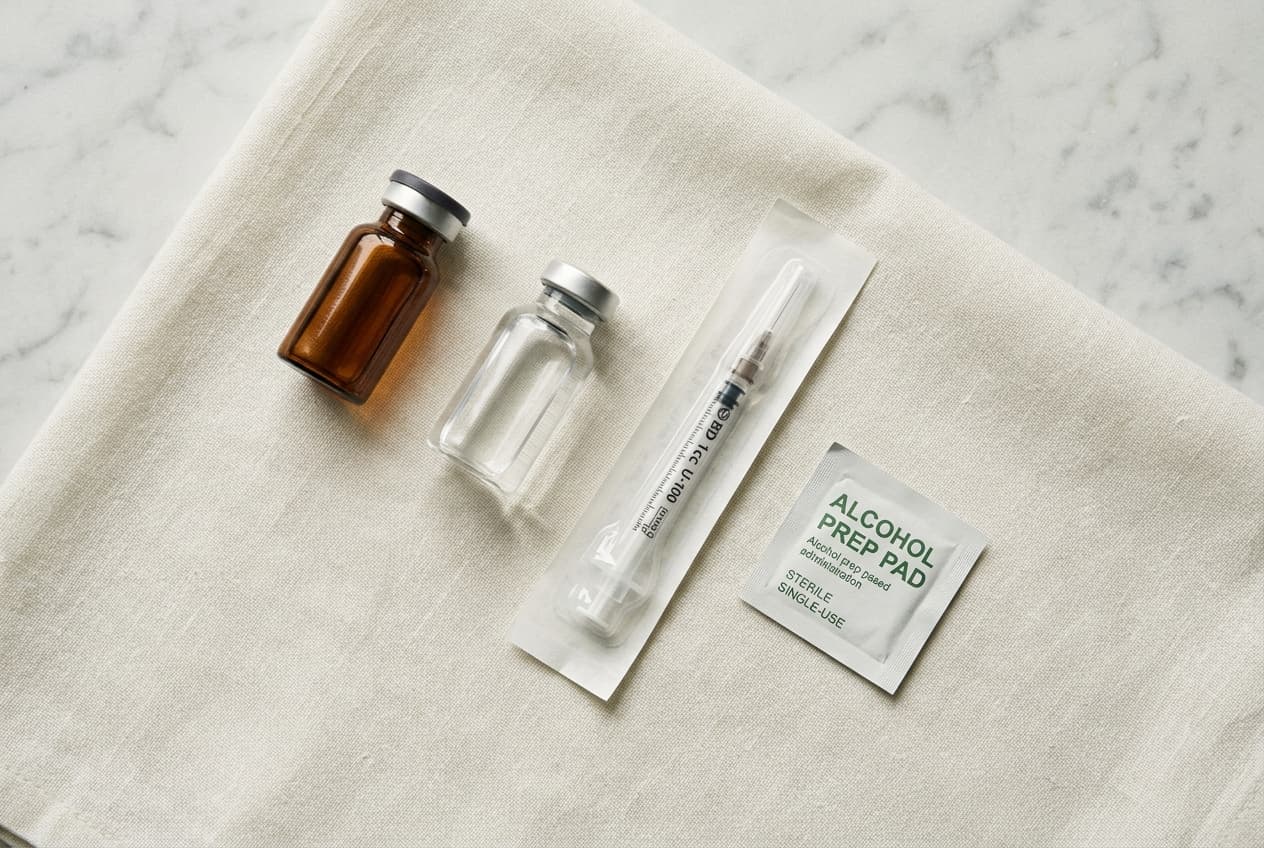
Pre-mixed multi-dose vial from a compounding pharmacy, typically 10 ml. Standard dose is 1 ml intramuscular or deep subcutaneous, 2-3 times weekly. Dose 30-60 minutes pre-workout on training days. Rotate sites; the volume is small but the blend can sting more than a single peptide. No reconstitution math because there is no powder.
Open calculator pre-filledStorage after reconstitution
Pre-mixed multi-dose vial from the compounding pharmacy. No reconstitution. Refrigerate at 2 to 8 °C, light-protected. Use within the labelled beyond-use date (typically 28 days from first puncture) or the printed pharmacy expiry, whichever is earlier. Do not freeze. Because the blend contains multiple peptides, the weakest-link kinetic determines overall shelf life. Respect the pharmacy date, do not stretch it.
Cost & sourcing red flags
Typical price range: $150 to 400 per multi-peptide blended vial from research-chemical suppliers, depending on which peptides are included. Per-dose cost typically lands at $5 to 15, but cycle economics depend entirely on which actives the specific blend contains.
Red flags
- Vendor refuses to disclose the exact mg-per-mL of each peptide in the blend. 'Super Human Blend' is a marketing name, not a defined formula. Without per-peptide concentrations, the user cannot dose intelligently and cannot detect underdosing.
- Pre-blended vials combining peptides with incompatible storage or stability profiles. For example, a copper peptide (GHK-Cu) co-formulated with a methionine-containing peptide (TB-500 fragment) in a single vial may oxidise on the shelf even if the short-term degradation rate looks acceptable in 30-day testing.
- Blends containing GLP-1 analogues (semaglutide, tirzepatide) co-formulated with healing peptides or growth-hormone secretagogues. GLP-1 stability and pH requirements differ enough that the combined formulation is unlikely to be stability-validated.
- No batch-specific HPLC/LC-MS COA listing each peptide identity and concentration separately. A single 'purity >98%' line for a blend tells you nothing. Each component needs its own quantitation.
- Marketing copy citing dramatic recomposition outcomes ('20 lbs lean gain in 12 weeks') from the blend itself. Multi-peptide stacks have the additive cost of each peptide, not multiplicatively additive effects; outcomes track the strongest single component plus the underlying diet and training.
- Pricing that equals or beats the sum of the individual peptides priced separately. A legitimate blended product should cost at least the sum of its inputs plus formulation labour. Discounted blends almost always mean at least one component is underdosed.
Pricing rots fast and varies by region and supplier. We list no vendors.
Common mistakes
Expecting it to function like a peptide.
Better approach: It is an amino-acid blend. No receptor agonism, no growth-factor signalling. The mechanism is just nutrition delivered intramuscularly. Frame the expectation accordingly - it is a convenience tool, not a pharmacological intervention.
Using it to replace a real recovery and training programme.
Better approach: Sleep, protein intake, and progressive overload do far more than any amino-acid injection. If the rest of your programme is loose, fix that before adding the blend. The injection cannot compensate for an unmeasured calorie surplus or a sleep deficit.
Dosing on rest days at the same volume as training days.
Better approach: The arginine/citrulline arm is most useful pre-workout. On rest days the marginal value drops. Either skip rest-day injections or drop frequency to twice weekly, both on training days.
Combining it with three other amino-acid stacks because they all 'should help'.
Better approach: You will not be able to attribute anything if you stack it with EAAs, BCAAs, citrulline-malate, and beta-alanine in the same week. Pick one strategy. Run it for 8 weeks. Assess. Then add.
Real-world tips
- Inject 30-60 minutes pre-workout for the pump and vasodilation benefit. That is the reliable subjective signal.
- Use a 1 inch 25-gauge needle for IM in the glute. Smaller needles do not always reach muscle and end up depositing the blend in subcutaneous fat, where it stings more.
- Rotate sites - glute, deltoid, vastus lateralis. Same-site repeat injections build a tender bump.
- Track training volume across the cycle. Body composition will not move from the blend; training capacity might. That is the metric to watch.
- If you also take oral creatine and a real protein intake, the blend adds less than the marketing suggests. That is fine - it is still a convenience format - just calibrate your expectation.
- Read your specific compounder's label. The 'Super Human Blend' brand is not standardised; one vendor's formula may differ meaningfully from another's.
What users report
Aggregated from r/Peptides, r/PeptidesHelp, and bodybuilding forum stacking threads. The label 'Super Human Blend' is not standardised. Actual formulas vary by vendor. Not clinical data.
Onset: Users describe the felt effect tracking whichever component in the blend acts fastest. If a GH secretagogue (ipamorelin, CJC-1295) is included, deeper sleep within 3 to 5 days; if BPC-157 or TB-500 dominate, recovery-focused effects landing at week 2 to 3.
Common reports
- Deeper, more vivid sleep and easier morning waking in the first week when the blend contains a GH secretagogue. Most users attribute this to the ipamorelin or CJC component specifically.
- Faster recovery between heavy training sessions, particularly for tendinous or joint complaints, when BPC-157 and TB-500 fragments are in the formula.
- Mild water retention and a fuller muscle look at week 2 to 4 of GH-secretagogue-containing blends, sometimes mistaken for lean tissue gain.
- Injection-site reactions range widely depending on what is in the blend. Copper peptide components produce more bruising, GH secretagogues produce mild flushing, healing peptides are generally well-tolerated.
- A common report is 'I cannot tell which component is doing the work'. Running pre-blended formulas makes attribution to individual peptides impossible, which is both the convenience and the limitation.
Where reports diverge from theory: The marketing pitch for blends is synergy. That combining BPC-157, TB-500, GH secretagogues, and sometimes AOD9604 or MOTS-c into one shot delivers more than the sum of the parts. There is no controlled human data supporting synergistic effects between these specific peptides; the rationale is mechanism-stacking, not measured potentiation. Forum reports broadly match what each individual component would predict, which suggests the blend is mostly convenience packaging. The real downside is that running a blend prevents the user from titrating individual peptides, identifying which one is causing a side effect, or rotating one out for assessment. Users who hit issues on a blend almost always end up unblinding by running each peptide individually afterwards.
When something else is the better tool
Oral citrulline malate, oral creatine, dietary protein
Use instead when: Almost always. The oral versions of these compounds have the trial evidence, cost less, and do not require needles. The injection-format advantage is convenience for users already comfortable injecting, not superior efficacy.
A single-component peptide aimed at your actual goal
Use instead when: You have a defined goal. If you want connective-tissue repair, BPC-157 is the targeted tool. If you want GH-mediated recovery, CJC-1295/Ipamorelin is targeted. The blend's appeal is its breadth, which is also why no single arm of it is the right answer for a specific problem.
Properly programmed lifting plus sleep and protein
Use instead when: You are still in the first 1-2 years of serious training. The fundamentals are doing 95 percent of the work at that stage. The injection adds noise more than signal. Come back to the blend question once your programming, nutrition, and sleep are dialed in.
Based on 1 peer-reviewed study
- Is this a peptide?
- No. It is an injectable amino-acid blend. The clinics that sell peptides usually also sell it, which is why it gets shelved under the peptide umbrella, but mechanistically it is closer to a fortified IV vitamin than to a research peptide.
- Will it build muscle?
- Not directly. It supports training capacity slightly. The muscle is built by the training and the protein, not by the injection. If you train hard and eat enough, the blend is at best a small extra lever.
- Can I run it long-term?
- The individual amino acids are safe at the doses involved, indefinitely, in healthy users. The blend-as-a-unit has not been studied for chronic use. 12 weeks on, 4 off, is the conservative pattern; many users run it continuously without trouble.
- Why does the formula differ between vendors?
- Because the brand is descriptive, not patented. Every compounding pharmacy mixes its own blend within the same general theme. Pick one compounder, learn how their formula treats you, and stay with it.
- Is it WADA-compliant?
- The amino acids individually are not banned. Carnitine has volume restrictions for intravenous administration in sport (Method M2); the IM doses in Super Human Blend sit below that threshold but check the current WADA list yourself.
Last updated:
Related peptides
Other compounds in this category
- HGH (Somatropin)Recombinant human growth hormone. The actual hormone itself, not a secretagogue. Powerful for body recomposition, with side effects that scale unmistakably with dose.
- CJC-1295 / IpamorelinThe workhorse GH-secretagogue stack: a GHRH analogue paired with a selective ghrelin agonist. GHRH plus GHRP produces more GH per pulse than either alone, with a side-effect profile most people find tolerable for indefinite use.
- IpamorelinA selective ghrelin-receptor agonist that triggers a GH pulse without raising cortisol or prolactin. The property that made it the default GHRP and pushed the older, dirtier GHRPs to the margins.
- CJC-1295 (no DAC)A short-acting GHRH analogue. The GH pulse it produces is sharp, brief, and very close to what the pituitary does on its own. Stabilised against rapid breakdown, but without the albumin-binding modification that turns it into the long-acting DAC version.
- IGF-1 LR3The growth signal one step downstream of GH, with an extended half-life and a real hypoglycaemia risk. The most directly anabolic peptide a non-medical user can buy, and the one with the most teeth.