

GHK-Cu
Also known as: Copper Peptide · Glycyl-L-Histidyl-L-Lysine Copper
The copper-binding tripeptide your skin loses with age. Strongest evidence is topical for skin and wound healing; injectable use is mostly anecdotal.
Overview
GHK is a short, naturally occurring tripeptide (glycyl-L-histidyl-L-lysine) that the human body produces in plasma and that binds copper(II) with high affinity. Tissue levels drop with age, which is part of what put it on the anti-aging map. Topical evidence is the cleanest part of the file. Randomised trials of GHK-Cu creams show measurable improvements in skin density, fine lines, and wound healing. The injectable case is thinner. Most claimed systemic benefits (hair regrowth, joint repair, gut healing) rest on cell-culture data and user reports rather than human trials.[1]
Evidence quality
Topical cosmetic and wound-healing data is the strongest part of the literature. Small but real RCTs from the 1990s and 2000s for skin firmness, wrinkle depth, and diabetic ulcer healing. Loren Pickart's group has been the principal driver of this research for decades. Injectable systemic use has minimal human trial data and the gene-modulation claims that circulate online come from in vitro work, not clinical trials.
Benefits & timeline
Benefits
- Topical: measurable improvement in skin firmness, fine lines, and barrier function over 8 to 12 weeks of consistent use
- Wound healing. Older but solid clinical literature, including studies in diabetic foot ulcers
- Some users report hair regrowth at the temples and crown with topical or scalp-injected protocols
- Anti-inflammatory and mild antioxidant activity, plus a copper-delivery effect that supports collagen and elastin synthesis
Timeline
Week 2
Skin starts to feel slightly softer; barrier improvements show up before visible changes.
Week 4
Visible reduction in fine lines and improvement in tone for topical users; injectable users sometimes notice the same plus a subtle skin colour shift.
Week 8 to 12
Plateau of the cosmetic effect. This is the window where you assess whether it's working.
Off-cycle
4 weeks off lets you see whether the gains hold without continuous dosing.
Dosage protocols
Advanced
3 mg
three times weekly
Beginner
1 mg
twice weekly
Standard
2 mg
three times weekly
Titration & adjustment
Start at 1 mg subcutaneously twice weekly. After 2 weeks escalate to 2 mg three times weekly. Maximum 3 mg three times weekly. Topical forms (creams at 1 to 2% GHK-Cu) can be used daily without titration.
Injection timing

Subcutaneous 2 to 3× weekly. Time of day does not matter. Topical creams: apply morning and evening on clean skin, ideally before sunscreen in the AM.
Side effects & contraindications

- mildInjection-site soreness or a small bluish bump that resolves in 24 to 48 hours. The copper colour is normal.
- mildTopical irritation in sensitive skin, usually from the carrier rather than the peptide.
- mildTransient drop in blood pressure with high subcutaneous doses in some users. Minor, but worth noting if you're already on antihypertensives.
- moderateNo long-term human safety data for injectable use at the doses people are running.
Contraindications
- Wilson disease. Copper handling is exactly what you don't want to challenge in someone whose body cannot clear it
- Active cancer. The peptide promotes angiogenesis and tissue regeneration, both of which are double-edged in this context
- Pregnancy and breastfeeding. No safety data
- Caution if you're already supplementing copper at high doses; the peptide brings its own
Reconstitution & injection
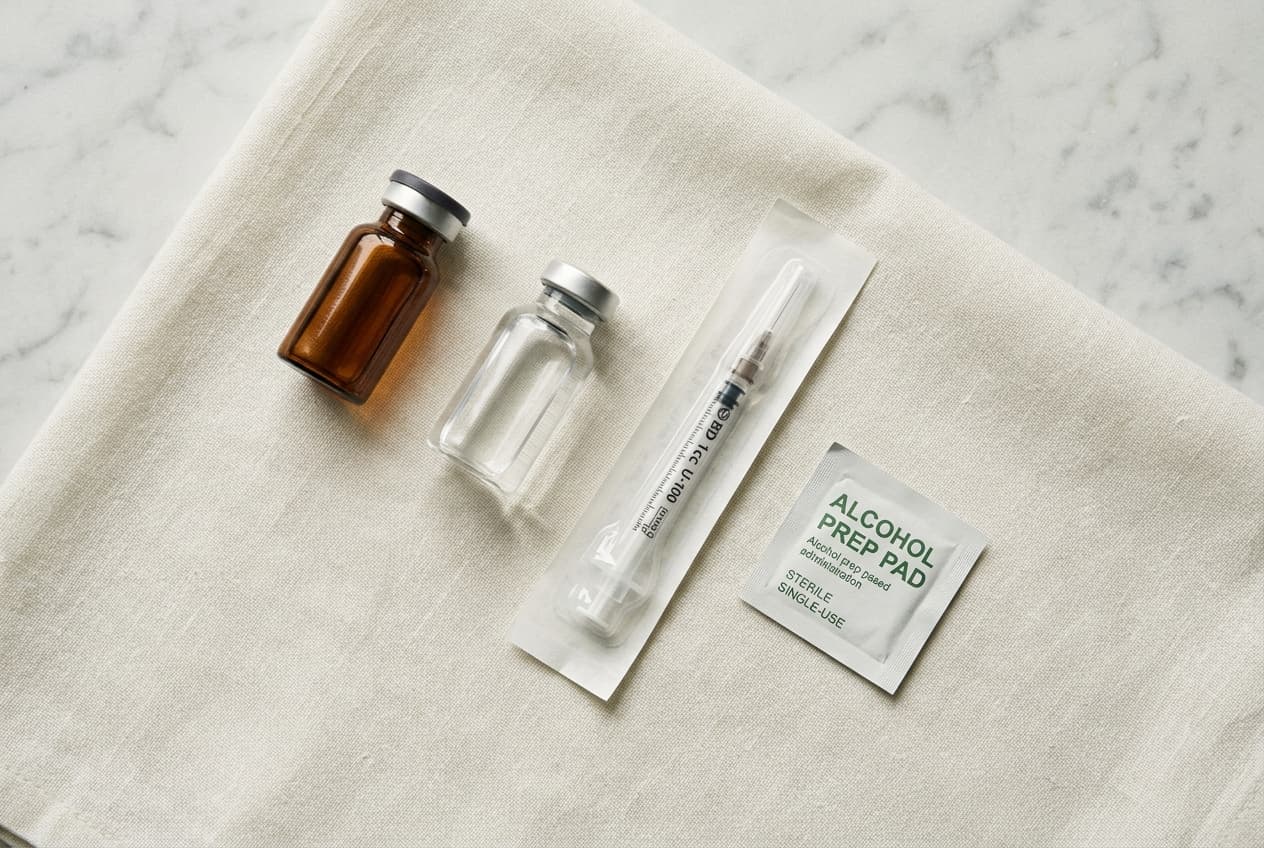
A 50 mg vial reconstituted with 2 ml bacteriostatic water gives 25 mg/ml. A 2 mg dose is 0.08 ml, which is 8 units on a U-100 insulin syringe. The reconstituted liquid takes on a distinct blue colour. That's the copper, and it's correct. Subcutaneous injection rotates around the abdomen or thigh. For topical use, dissolved GHK-Cu at 1 to 2% in a clean carrier (a hyaluronic acid serum works) is the standard formulation; apply morning and evening on cleansed skin.
Open calculator pre-filledStorage after reconstitution
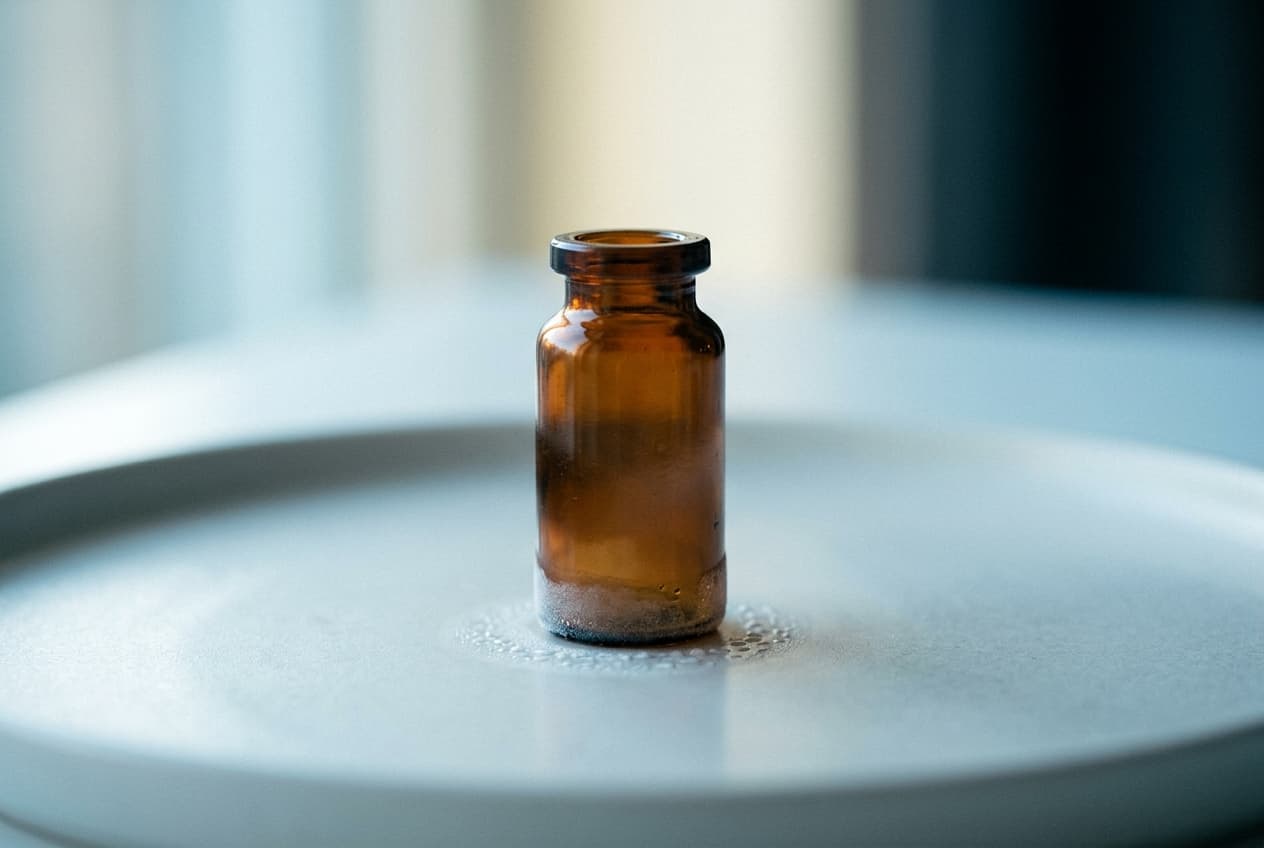
Refrigerate at 2 to 8 °C after reconstitution. Do not freeze. Light-protected (less critical than for NAD+ but still good practice). 28 to 30 days of stability at fridge temperature in BAC water. The characteristic blue/teal colour will deepen over the dosing window. This is the copper-peptide complex behaving normally and is NOT a degradation signal. Cloudiness or precipitate is a degradation signal; deepening colour is not. Topical GHK-Cu serums: follow the product label; most are stable at room temperature for the printed shelf life.
Cost & sourcing red flags
Typical price range: Research-grade injectable GHK-Cu runs $30 to 80 per 50 to 100 mg vial. Compounded prescription GHK-Cu cream or injection from US wellness pharmacies costs $80 to 250 per month. Cosmetic-class GHK-Cu serums occupy a parallel pricing universe: The Ordinary's Multi-Peptide + Copper Peptides 1% sits around $30 for 30 mL, while Skinceuticals and prestige brand copper peptide serums run $100 to 200 per 30 mL bottle. The cosmetic and injectable categories are different products at different concentrations and the price comparison only matters if you understand which one delivers what.
Red flags
- Injectable vials advertised as 'GHK-Cu' but lacking the deep blue colour after reconstitution. The copper-glycyl-histidyl-lysine complex is intensely blue at concentrations above 1 mg/mL; a faint blue or clear solution means the copper is not properly chelated, or the product is free GHK without copper.
- Cosmetic serums marketed at '1% copper peptides' without specifying whether the 1% refers to GHK-Cu or a peptide blend that includes GHK-Cu as a minor component. The Ordinary's 1% Multi-Peptide product contains GHK-Cu mixed with five other peptides; the effective GHK-Cu concentration is well under 1%.
- Vendors recommending intravenous GHK-Cu administration. Free copper in plasma is toxic at concentrations a syringe of injectable GHK-Cu can hit; the compound is intended for topical, intranasal, or carefully-dosed subcutaneous use.
- Research-grade vials priced under $20 per 50 mg with no specified copper-content ratio. A genuine GHK-Cu 1:1 molar complex requires copper sulfate in the formulation; a vial that fails to declare its copper content is not selling the same molecule.
- Cosmetic products that combine GHK-Cu with high-vitamin-C serums in the same routine. Ascorbic acid reduces Cu²⁺ to Cu⁺ and disassembles the complex; reputable cosmetic chemists flag the incompatibility, and a product that ignores it is one to skip.
- Compounded subcutaneous GHK-Cu prescribed without total daily copper-dose tracking. Repeated high-dose injections can drive cumulative copper exposure into the range where ceruloplasmin saturation and free copper symptoms become real concerns.
Pricing rots fast and varies by region and supplier. We list no vendors.
Common mistakes
Injecting systemically and expecting topical-grade skin results.
Better approach: The strongest skin evidence is for topical formulations applied directly to the area you want to improve. Subcutaneous injection in the abdomen is unlikely to outperform a well-formulated cream applied to your face.
Stacking it with high-dose vitamin C topical.
Better approach: Ascorbic acid reduces the copper in GHK-Cu and breaks the complex. Layer them on opposite ends of the day (vitamin C in the morning, GHK-Cu in the evening) or in alternating routines. Same skincare benefit, no cancellation.
Running it indefinitely without an off-cycle.
Better approach: The skin remodelling effect plateaus around week 12. Continued daily exposure beyond that doesn't add visible improvement and slowly accumulates copper. Cycle 8 to 12 weeks on, 4 weeks off.
Buying it as a generic 'copper peptide' powder.
Better approach: Quality varies wildly. The peptide is hygroscopic, copper content matters, and the difference between a working product and a useless one is real. Buy from a source that publishes a certificate of analysis, or formulate from a known-quality raw.
Real-world tips
- The blue colour is the copper. If your reconstituted vial isn't faintly blue, you may have purity issues with the raw.
- Store reconstituted vials in the fridge; copper-binding peptides degrade faster than naked peptides at room temperature.
- Layer topical GHK-Cu underneath moisturiser, not on top. The barrier-occlusive layer goes last.
- Photo-track. The visible improvements happen slowly enough that day-to-day memory can't see them; weekly photos in consistent lighting can.
- For hair claims, scalp microneedling combined with topical GHK-Cu is the protocol with the most anecdotal traction. Solo topical without microneedling is much weaker.
What users report
Aggregated from r/Peptides, r/HairLoss, r/SkincareAddiction, and r/tressless. Not clinical data.
Onset: Topical users describe the first visible skin texture change around week 4 to 6 of twice-daily use; subcutaneous and intranasal users report a felt change (warmth, mild flush) within 5 to 15 minutes of dose but the structural skin and hair effects still take 6 to 12 weeks to surface.
Common reports
- Warmth and visible flushing across the face, neck, and upper chest within 5 to 15 minutes of subcutaneous injection, fading by 30 minutes. Forum users attribute this to copper-driven vasodilation rather than the peptide.
- Skin texture improvement (smoother feel, less crepey under-eye) at week 4 to 6 of topical use; this matches the 12-week clinical trial endpoint for collagen and elastin synthesis.
- Slowed shedding and slightly thicker regrowth at scalp injection sites in tressless community reports, generally over 3 to 6 months. Effects are modest compared to minoxidil or finasteride and rarely sufficient as monotherapy.
- Faint bluish-brown discoloration at sites injected repeatedly with concentrated GHK-Cu, attributed to copper deposition in subcutaneous tissue. Rotating sites resolves it.
- Mild itch or pinkness at the topical application site for the first week; usually resolves once the skin acclimates.
- Sleep quality reports are split. Some users describe deeper sleep on intranasal dosing while others see no change. The reported effect is smaller and less consistent than what users describe with semax or selank.
Where reports diverge from theory: GHK-Cu's published mechanism is topical/local. Collagen synthesis, dermal fibroblast stimulation, hair follicle stem cell activation at the application site. Forum communities increasingly use it subcutaneously as a 'systemic anti-aging' peptide, framing it as helping organ-level regeneration based on the 2018 gene-modulation paper by Pickart. The human pharmacokinetic data for subcutaneous GHK-Cu is thin, and whether systemic dosing produces clinically meaningful effects at tissues distant from the injection site is not established. The cosmetic literature is real; the systemic regeneration story is speculative.
When something else is the better tool
Topical retinoids
Use instead when: The primary goal is anti-aging and the budget only stretches to one active. Tretinoin has decades of evidence and is cheaper. Add GHK-Cu as a layered companion if you tolerate retinoids well.
BPC-157
Use instead when: The need is acute tissue injury (tendon, ligament) rather than slow cosmetic remodelling. BPC-157 is faster and more localised; GHK-Cu is slower and more cosmetic.
Microneedling with PRP
Use instead when: Skin density and texture is the target and you have access to a clinic. Mechanical and growth-factor mechanisms are complementary; many users do GHK-Cu plus periodic microneedling sessions.
Based on 1 peer-reviewed study
- Topical or injectable?
- For skin, the topical case is stronger and the side-effect ceiling lower. Injectable becomes more interesting for systemic goals (joints, hair, general anti-aging) but the evidence there is anecdotal.
- Do I need a separate copper supplement?
- No. The peptide is named GHK-Cu because the copper is already bound. Additional supplementation can disrupt the binding.
- Why is my injection bluish?
- Copper absorbs in the red end of the spectrum, so the solution looks blue. Normal; local discoloration at the injection site fades in a day or two.
- Can I dose more often?
- Past three injections weekly the dose-response goes flat. More frequent injections give you more soreness without more benefit.
- Does it work for hair?
- The weakest part of the file. Scalp-applied topical with microneedling has the most anecdotal traction; oral and systemic use for hair is essentially unsupported.
Last updated:
Related peptides
Other compounds in this category
- Melanotan-2The unregulated tanning peptide. Cheaper and more effective on libido than MT-1, but the side effect profile and mole-change risk make this the riskier of the two.
- Melanotan-1An α-MSH analogue approved in the EU and US as Scenesse (afamelanotide) for erythropoietic protoporphyria. The off-label tanning use is what most people actually want it for.
- SNAP-8A topical octapeptide marketed as a 'Botox alternative'. The mechanism is real; the magnitude is nothing like an injection.
Head-to-head
Direct comparisons with similar peptides