
BPC-157
Also known as: Body Protection Compound · Pentadecapeptide BPC-157
A 15-amino-acid stretch lifted from a protein in human gastric juice. Best-known use is soft-tissue repair, with a quieter second life as a gut-healing protocol.
Overview
BPC-157 sits in an awkward spot: animal data is impressive (tendons, ligaments, gut lining, peripheral nerve, all healing faster than controls across dozens of rodent studies) and human data is almost nonexistent. People use it anyway, mostly because it tends to work for the kinds of nagging injuries (chronic Achilles, golfer's elbow, tweaky knees) that don't respond to rest or PT. Mechanism story is plausible: it appears to upregulate growth-factor receptors locally and accelerate angiogenesis at the injection site. Whether that translates to humans as cleanly as it does to rats is still the open question.[1][2]
Evidence quality
Dozens of rodent and rat studies, mostly from a single Croatian research group (Sikiric and colleagues) that has been investigating this peptide since the 1990s. The replication base outside that group is thin. No completed human RCTs are in the public literature. Use anecdotal-plus-animal as your evidence floor, not as a substitute for the clinical trials that have not been done.
Benefits & timeline
Benefits
- Faster recovery from chronic tendon and ligament injuries (animal evidence strong, human evidence anecdotal)
- Quiets gut inflammation; popular adjunct for IBD, NSAID-related gastritis, and post-antibiotic recovery
- Reduces joint discomfort during heavy training blocks
- Localised effect when injected near the injury. Site-of-administration matters more than total dose
Timeline
Week 1
Subtle drop in baseline pain. Easy to miss if you are not tracking it.
Week 2
Range of motion improves before pain fully resolves.
Week 3 to 4
Most users report the injury feels noticeably more durable.
Week 6
Plateau. If nothing has shifted by here, more weeks rarely help.
Off-cycle
4 weeks off lets you assess whether gains hold without ongoing dosing.
Dosage protocols
Advanced
750 mcg
split AM/PM
Beginner
250 mcg
once daily
Standard
500 mcg
split AM/PM
Titration & adjustment
Start at 250 mcg once daily near the injury site. After 1 week, escalate to 500 mcg daily (split AM/PM) if no improvement. Maximum 750 mcg daily. For gut healing, oral capsules at the same total daily dose work well. Cycle off for 4 weeks every 4 to 6 weeks.
Injection timing
Twice daily (morning + evening) splits keep tissue levels steady. Injection site should be as close to the injury as anatomically reasonable. For joints, inject subcutaneously adjacent; for deep tendon/ligament, intramuscular near the site. For gut healing, oral capsules with meals.
Side effects & contraindications

- mildInjection-site soreness or a small bump for 24h.
- mildMild headache in the first few days. Usually fades.
- mildTransient nausea with oral capsules, especially fasted.
- moderateNo long-term human safety data. The compound has been in research and grey-market use since the 1990s without major signal, but "no signal yet" is not the same as "safe long-term".
Contraindications
- Active cancer or recent cancer history. Angiogenesis is the exact mechanism you do not want to amplify
- Pregnancy or breastfeeding
- No pediatric data
- Caution with concurrent corticosteroid use; the two work in opposite directions on the repair pathway
Reconstitution & injection
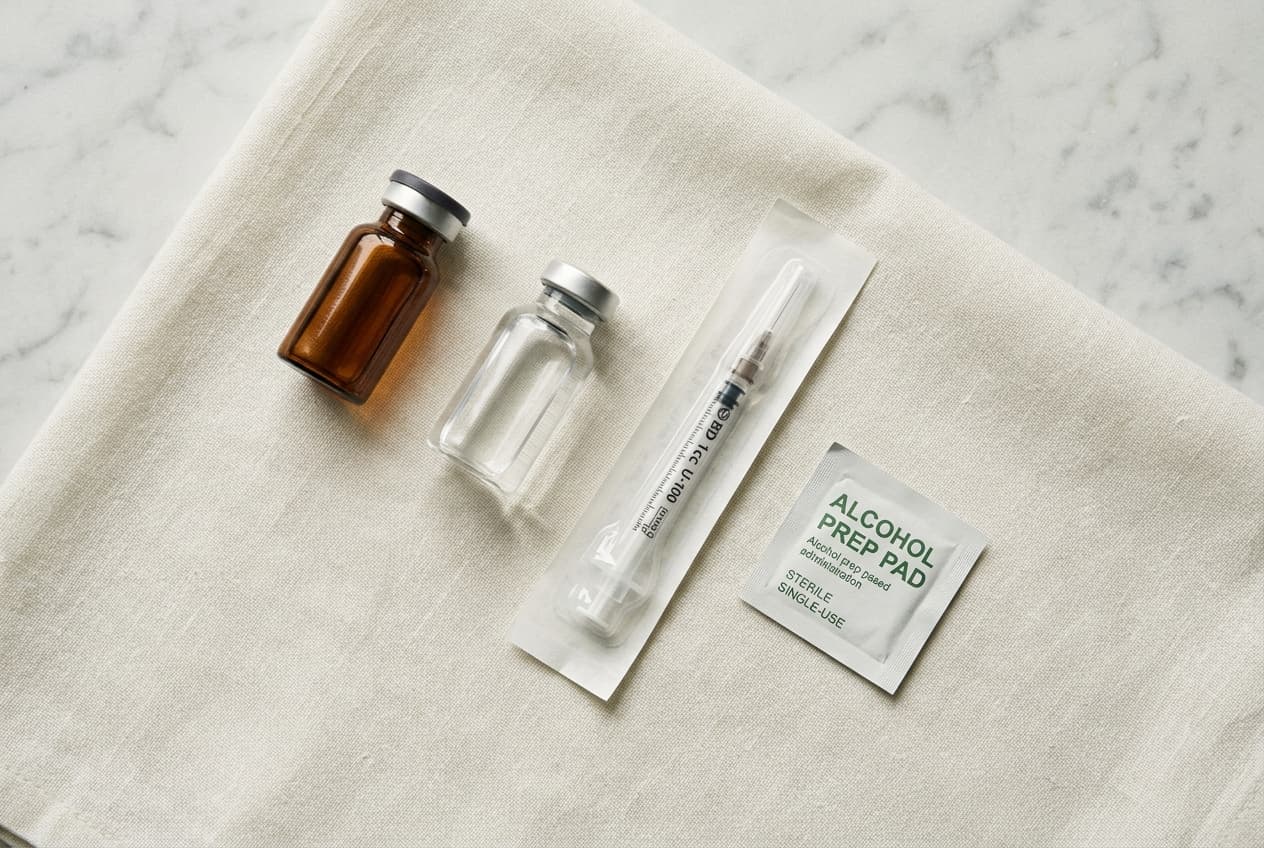
A 5 mg vial mixed with 2 ml bacteriostatic water gives 2.5 mg per ml. That means a 250 mcg dose is 0.1 ml, which is 10 units on a U-100 insulin syringe. For injuries you can reach, inject as close to the site as the anatomy allows; subcut for joints and superficial tendons, intramuscular near the belly of the muscle for deep tendon or ligament work. For gut issues, oral capsules dosed with food work. Peptide breakdown in the stomach is less of a problem than was initially assumed.
Open calculator pre-filledStorage after reconstitution
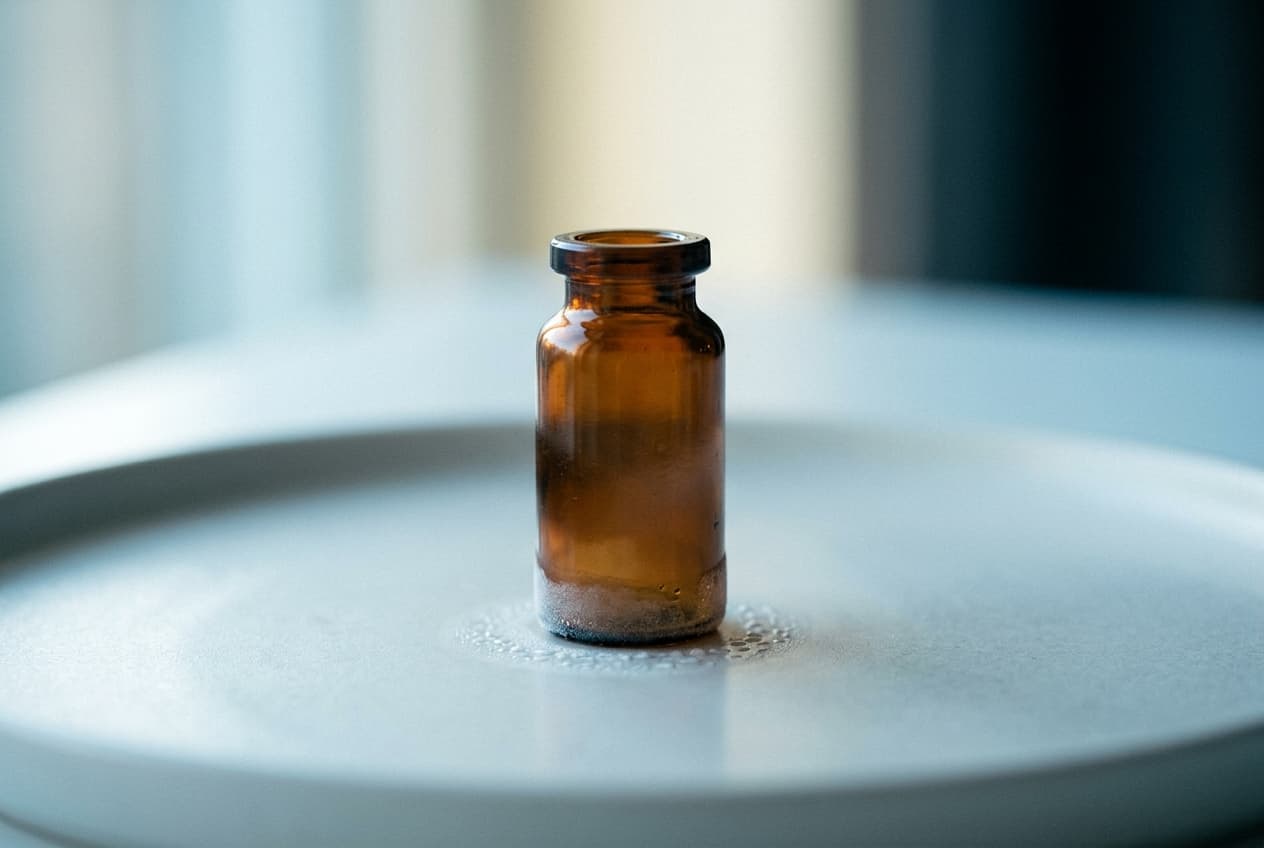
Refrigerate at 2 to 8 °C after reconstitution. Do not freeze. Light-protected. BPC-157 in BAC water has a shorter realistic window than most peptides. 14 to 21 days at fridge temperature. Some sources claim 28 days; bench studies show measurable degradation by day 21. The conservative play is to reconstitute small volumes (e.g. 5 mg in 2 ml = 2.5 mg/ml) and finish a vial in 2 to 3 weeks. Cold storage in sterile saline (instead of BAC water) extends stability marginally but BAC is the standard.
Cost & sourcing red flags
Typical price range: $30 to 60 per 5 mg vial from research-grade suppliers; oral capsules $40 to 80 per 60-count bottle. A 4-week injectable cycle costs $30 to 50 in raw material.
Red flags
- 5 mg vials priced under $20. Independent assays of bargain vials routinely show 30 to 60% of labelled peptide.
- No third-party HPLC or mass-spec certificate of analysis (COA) tied to the specific batch number. A generic 'purity >99%' PDF that is not batch-specific is not a COA.
- Vials arriving clear and watery rather than the expected white-puck lyophilised powder. This often means the peptide failed lyophilisation or was diluted post-synthesis.
- Suppliers selling 'oral BPC-157' that is just the injectable powder in a capsule with no enteric coating. Without enteric protection, gastric acid destroys most of the dose before it reaches the small intestine.
- Pricing that drops by >40% during 'holiday sales' from suppliers who do not normally discount. A common pattern when batches are nearing expiry.
Pricing rots fast and varies by region and supplier. We list no vendors.
Common mistakes
Injecting far from the injury and hoping for systemic effect.
Better approach: The site-specific data is the strongest part of the animal literature. Inject within a few centimetres of the injured tissue. If you cannot reach the area cleanly, consider whether oral dosing fits the use case better (gut) or whether TB-500 is the more honest pick (systemic).
Stacking it with steroids during the same recovery window.
Better approach: Corticosteroids suppress the same growth-factor signalling BPC-157 appears to amplify. If you have a flare that requires a steroid course, pause the peptide until that is finished, then resume.
Running it indefinitely.
Better approach: The repair effect plateaus by about week 6. Beyond that you are paying for vials with diminishing return. Cycle 4 to 6 weeks on, 4 weeks off, and use the off period to gauge whether the gains hold.
Treating a 250 mcg dose as a fixed law because someone on a forum said so.
Better approach: The dose response is shallow in animal work. 250 mcg twice daily is the common protocol, but going to 500 mcg twice daily rarely produces a bigger effect. The variable that actually matters is consistency and proximity to the injury, not chasing higher numbers.
Real-world tips
- If injecting near a tendon, pinch the skin and go slowly. Small needles still feel sharper over bony landmarks.
- Refrigerate after reconstitution. Most users see no potency loss for 4 weeks at fridge temperature in bacteriostatic water.
- Track one objective measure (range of motion, single-leg hop, grip strength) weekly. Pain scores drift; an objective measure tells you whether you are actually getting better or just feeling better.
- Oral and injected protocols can be combined for gut + tendon injury overlap. The two routes do not compete.
- Plan the off-cycle. Most people who feel like the peptide "stopped working" have been on it for 8+ weeks straight; the body is telling you to stop, not to escalate.
What users report
Aggregated from r/Peptides, r/PeptidesHelp, and forum threads. Not clinical data.
Onset: Most users describe a subtle drop in pain or stiffness within 5 to 10 days of starting; the more durable 'injury feels stable' shift lands around week 3 to 4.
Common reports
- Tendon and ligament pain quiets faster than physiotherapy alone would predict. Most reported for Achilles, lateral elbow, and patellar tendon.
- Gut symptoms (acid reflux, IBS flare, NSAID-related gastritis) improve within the first 7 to 10 days of oral dosing.
- Mild headache for the first 2 to 3 days of injectable cycles. Usually resolves by end of week 1.
- Site-of-injection bruising is more common than the literature implies, especially with insulin syringes used past their sharpness.
- 'Feels like nothing' reports are common in the first 7 days. The effect is not a felt acute hit like a stimulant; it is a week-over-week trajectory change.
Where reports diverge from theory: Forum reports frequently describe systemic effects (better sleep, mood lift, generalised gut improvement) from subcutaneous injection at a tendon site. The animal literature only supports local site-of-administration effects. Whether subcutaneous delivery produces measurable systemic peptide levels in humans is unresolved; treat the systemic claims as anecdotal.
When something else is the better tool
TB-500
Use instead when: The injury is systemic or hard to localise (general training overuse, multiple small injuries, post-surgical full-body recovery). TB-500 is the more honest pick when there is no specific site to target.
GHK-Cu
Use instead when: The primary goal is connective-tissue quality and skin/hair rather than acute injury repair. GHK-Cu is slower and more cosmetic; BPC-157 is faster and more functional.
Targeted physical therapy + load management
Use instead when: You have not yet done the boring work. A peptide is not going to compensate for a missing eccentric loading programme on a tendon. Run the rehab protocol first; add BPC if you plateau.
Based on 2 peer-reviewed studies
- Subcutaneous or intramuscular?
- Subcutaneous near the injury for surface tendons, ligaments, and joints. Intramuscular when the target tissue sits deeper. Calf, hamstring, deep glute. Both work; proximity matters more than route.
- Does the oral version actually work?
- Yes for gut-targeted protocols (gastritis, IBD adjunct, leaky-gut symptoms). For tendon and ligament work, injected is the better tool.
- How long until I feel something?
- A subtle shift in pain or stiffness in the first two weeks; the injury 'forgets it was injured' around week 3 to 4. No change by week 6 means you are unlikely to find one at week 12.
- Is there a risk to long-term use?
- No human safety data either way. The grey-market track record is long without obvious signals. Reassurance, not proof. The cancer caution is the one to take seriously: angiogenesis is exactly the mechanism you do not want to amplify.
- Can I store reconstituted vials at room temperature?
- Fridge is safer. Room temperature in bacteriostatic water holds a few days then degrades. Travel with an insulated pouch and ice pack.
Last updated:
Related peptides
Other compounds in this category
- TB-500A synthetic fragment of Thymosin Beta-4 used for systemic tissue repair. Sister peptide to BPC-157, but where BPC works locally, TB-500 spreads.
- GLOW StackA pre-blended convenience vial containing TB-500, BPC-157 and GHK-Cu in one daily injection. Marketed as a recovery-plus-skin protocol.
- KLOW StackGLOW plus KPV. The same TB-500 + BPC-157 + GHK-Cu blend with an added anti-inflammatory tripeptide. Marketed at users with gut or chronic-inflammation overlap.
Head-to-head
Direct comparisons with similar peptides