

Dermorphin
Also known as: Tyr-D-Ala-Phe-Gly-Tyr-Pro-Ser-NH2
A heptapeptide from frog skin that is 30 to 40 times stronger than morphine at the mu-opioid receptor. Listed for completeness; the abuse risk is real.
Overview
Dermorphin is a μ-opioid receptor agonist originally isolated from the skin of South American Phyllomedusa frogs. It contains a D-alanine residue at position 2, unusual for a vertebrate peptide, which protects it from peptidase breakdown and contributes to its extreme potency. We include it on this site for educational completeness, not because we think it belongs in a recreational or wellness protocol. It is, functionally, an opioid: tolerance develops fast, dependence is a real risk, respiratory depression at high doses can kill, and there is no clean line between 'using it for pain' and 'using it for the opioid effect'. Legitimate research use exists in mammals at preclinical stages. Recreational and grey-market use is genuinely dangerous.[1]
Evidence quality
Animal pharmacology characterising potency, receptor binding, and analgesic profile dates to the 1980s. There are no completed human RCTs of dermorphin as a therapeutic. The peptide also surfaced as a doping agent in horse racing in the 2010s. That's what most of the modern news mentions of dermorphin actually refer to.
Benefits & timeline
Benefits
- Potent analgesia at very low doses (the only reason it has any research interest at all)
- Limited CNS penetration in some animal studies. Research interest in peripheral analgesia without central addiction signal, not yet borne out in humans
- Resistance to enzymatic degradation, giving a longer duration than endogenous opioid peptides
- Of clinical interest as a template for designing safer mu-agonists, not as a drug itself
Timeline
30 min post-dose
Onset of analgesia and the full opioid effect. Sedation, euphoria, respiratory slowing.
1 to 2 hours
Peak.
4 to 6 hours
Effect tapers.
Within 1 to 2 weeks of repeated use
Tolerance development. Doses needed for the same effect climb sharply.
Within weeks
Physical dependence. Withdrawal on cessation matches the conventional opioid withdrawal syndrome.
Dosage protocols
Advanced
500 mcg
as needed
Beginner
100 mcg
as needed
Standard
300 mcg
as needed
Caution: potent opioid analogue; dependency risk.
Titration & adjustment
Strictly as-needed. Never scheduled, never daily. Start at 100 mcg subcutaneously. Maximum 500 mcg per dose. Because dermorphin is a potent μ-opioid agonist, tolerance and dependence develop with regular use. Limit to no more than 2 to 3 doses per week.
Injection timing

Strictly as-needed for severe pain. Subcutaneous, onset 30 minutes, duration 4 to 6 hours. Never schedule daily. Tolerance and dependency develop quickly.
Side effects & contraindications

- severeRespiratory depression. The dose-limiting and life-threatening side effect, especially when combined with alcohol, benzodiazepines, or other CNS depressants.
- severeDependence and addiction. The high potency means small differences in dose translate to large differences in effect, which accelerates the spiral.
- severeOverdose risk from underestimating potency. Dermorphin is 30 to 40× morphine, and harm-reduction tables for morphine do not apply directly.
- moderateSedation, constipation, urinary retention. The full opioid side-effect package.
- moderateNo characterised long-term human safety data outside of research settings.
Contraindications
- Any personal or family history of opioid use disorder. The addiction signal is exactly what you don't want to expose to a more potent agonist
- Concurrent benzodiazepines, alcohol, or any other CNS depressant. The respiratory-depression risk is multiplicative
- Respiratory disease. Asthma, COPD, sleep apnoea
- Pregnancy. Opioid exposure in pregnancy produces neonatal abstinence syndrome
- No medical supervision. This peptide should not be self-administered outside a clinical setting
Reconstitution & injection
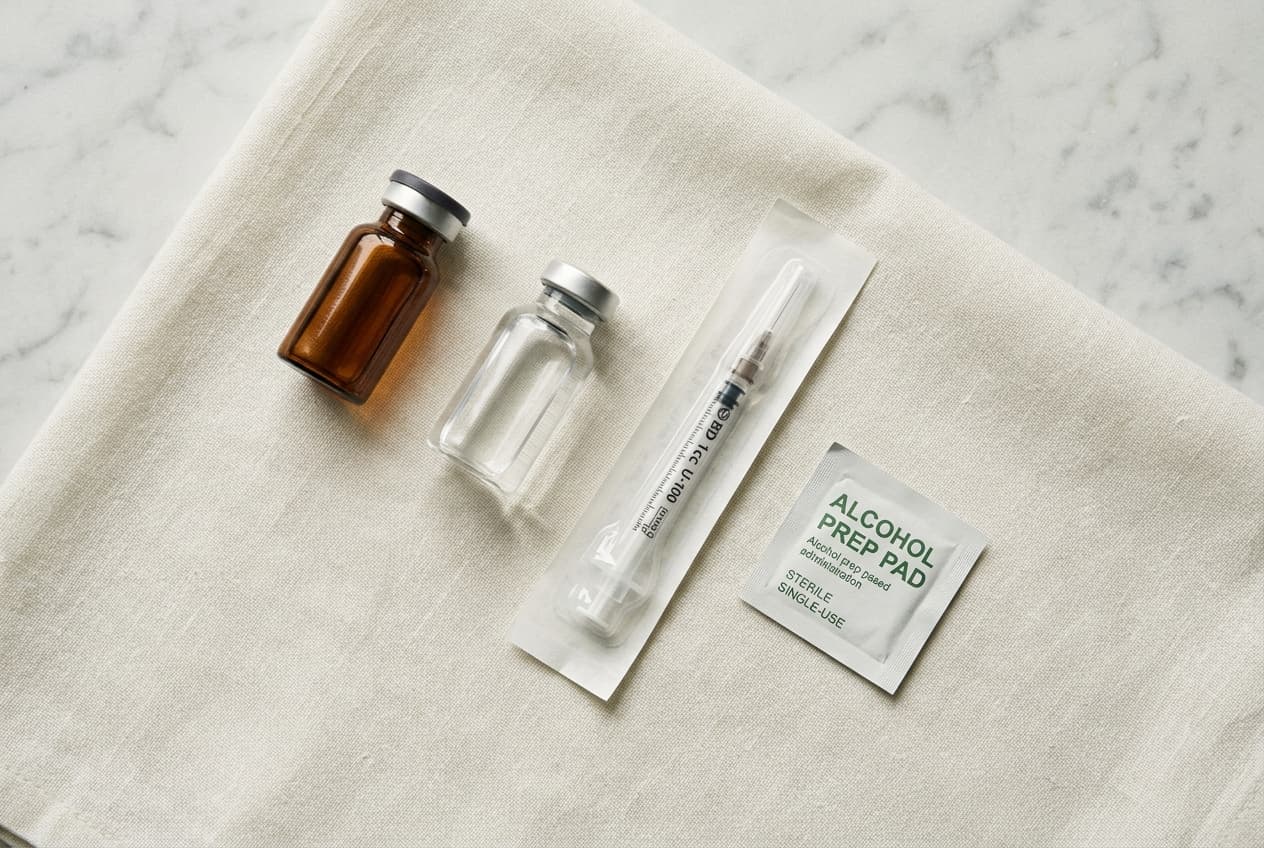
A 5 mg vial reconstituted with 2.5 ml bacteriostatic water gives 2 mg/ml. A 100 mcg starting dose is 0.05 ml, which is 5 units on a U-100 insulin syringe. We deliberately do not provide higher-dose conversions; if you're past the test-dose stage, you're past the point this site can responsibly guide you. Naloxone (Narcan) on hand is not optional. It's the only thing that reverses an opioid overdose, and a single intranasal dose can be the difference between a scary night and a fatal one.
Open calculator pre-filledStorage after reconstitution
Refrigerate at 2 to 8 °C after reconstitution. Do not freeze. Light-protected. 14 to 21 days of stability at fridge temperature. Because dermorphin is dosed as-needed for severe pain (not on a schedule), keep small reconstituted volumes and mix fresh batches as needed rather than holding a large volume across months.
Cost & sourcing red flags
Typical price range: Catalogue research-chemical suppliers list 1 mg vials at $80-200. Grey-market 'research peptide' sites sometimes show 5-10 mg vials at $200-500. Note that 1 mg of dermorphin is several hundred to a thousand human-equivalent doses by mu-opioid potency; the 'low' price masks an extreme dose-density and a correspondingly extreme overdose risk.
Red flags
- Any vendor framing dermorphin as a 'research peptide' suitable for injection. Dermorphin is a Schedule-relevant mu-opioid agonist with no human medical approval and well-documented respiratory-depressant pharmacology; legitimate research uses milligram quantities for in-vitro and rodent work, not for human self-administration.
- Multi-milligram vials sold without strict accountability or third-party purity confirmation. A 5 mg vial contains thousands of potentially lethal subcutaneous doses; this is not a peptide where 'underdosed' is the main risk, it is one where overdosing by a factor of 10 is a single pipetting error away.
- Vendors who ship to residential addresses without research-institution verification. US customs and DEA flag dermorphin imports; product seizures are routine, and packages routed around customs are often counterfeit fentanyl analogues sold under the dermorphin label.
- Marketing copy that compares dermorphin favourably to morphine on 'side-effect profile'. The published respiratory-depression data show the same mu-2-mediated apnoea mechanism as morphine, simply at 30-40x lower doses, which makes the therapeutic window narrower and the room for error smaller.
- Any clinic, telehealth service, or 'wellness' source offering dermorphin for pain or recovery. There is no legitimate human prescribing pathway anywhere in the world.
- Reports or forum posts encouraging IV self-administration. The single documented self-experiment account describes a 150 mcg IV bolus producing a rush within seconds and notes that injecting the full 1 mg vial would be rapidly fatal; the dose-response curve is too steep for home administration to be defensible.
Pricing rots fast and varies by region and supplier. We list no vendors.
Common mistakes
Treating it like an exotic recovery peptide.
Better approach: It is not in the same category as BPC-157 or thymosin. The opioid pharmacology is the dominant feature. If you wouldn't inject yourself with a tincture of morphine, don't inject this.
Underdosing the danger because the substance is a peptide.
Better approach: 'Peptide' is a chemical description, not a safety category. The endorphins are also peptides; so is heroin's molecular cousin in this case. Potency × poor characterisation × grey-market purity is a bad combination.
Mixing with anything sedating.
Better approach: Most opioid overdose deaths involve a second depressant. Alcohol, benzodiazepines, sleep medications, gabapentin. Any of them with dermorphin is the configuration that puts people in the ER.
Using it for chronic pain self-management.
Better approach: Chronic pain protocols belong in a pain clinic where the prescriber can adjust, taper, and monitor. The grey-market route gives you no second pair of eyes when things go sideways.
Real-world tips
- Have naloxone in the room before any dose. Intranasal 4 mg is the standard form; one or two doses reverse an overdose long enough for emergency services to arrive.
- Don't be alone. Opioid respiratory depression doesn't wake you up. Someone else has to.
- Don't escalate dose to chase the effect. That's the path to dependence and the path to overdose, and they're the same path.
- If you have used it more than a few times and feel the pull to use it again, treat that signal seriously. It's the early phase of dependence and it's the right time to stop.
- Tell your doctor. Real medical guidance beats internet protocols here by a wide margin.
What users report
Almost no legitimate human report base exists. The few accounts on Drugs-Forum and erowid-style sites are anonymous self-experimentation by a handful of people; this is not a peptide with a community of users.
Onset: The one detailed IV self-report describes onset within 10-15 seconds of a 150 mcg dose, with the rush itself lasting under a minute and no sustained analgesia or euphoria at sub-lethal doses.
Common reports
- Brief opioid rush at IV doses around 100-200 mcg, described as 'similar to heroin' in the initial seconds and accompanied by anxiety rather than calm.
- Sublingual and intranasal routes at 150-400 mcg produced no felt effect in the published self-report, suggesting poor non-IV bioavailability and reinforcing why this molecule is not a recreationally viable opioid.
Where reports diverge from theory: Theory and the rodent literature say dermorphin is a potent mu-1 selective agonist with strong analgesia at very low doses and rapid respiratory depression at higher ones. The handful of human self-reports describe an unsatisfying rush without sustained euphoria or analgesia, and a dose range so narrow that doses high enough to feel anything sit alongside doses high enough to stop breathing. This is not a peptide where 'try a small amount and titrate' is a workable approach. The honest read of the data is that there is no safe self-administration protocol, and the forum-level interest in dermorphin tracks novelty rather than any actual user-base outcome.
When something else is the better tool
Medically prescribed opioids for legitimate pain
Use instead when: Always. If your pain warrants opioid therapy, the answer is a prescriber, a monitoring plan, and a drug with a known purity and dose. Not a grey-market peptide.
Non-opioid analgesics (NSAIDs, gabapentinoids, duloxetine, topical lidocaine)
Use instead when: For most chronic pain syndromes outside cancer and post-surgical contexts. The risk-benefit math beats opioids of any kind, dermorphin included.
PEA, palmitoylethanolamide
Use instead when: Mild-to-moderate neuropathic pain where the goal is endocannabinoid-style analgesia without the abuse profile. Modest evidence, vastly better safety.
Based on 1 peer-reviewed study
- Why is this on the site at all?
- Because the site is a dictionary, and an honest dictionary doesn't omit difficult entries. We'd rather you read about dermorphin here, in context, with the risks laid out, than encounter it on a forum that promises it's a 'safe natural alternative'. It isn't.
- Is there a safe protocol for recreational use?
- No. Recreational use of a μ-agonist 30× morphine's potency is what addiction medicine calls 'high-risk by definition'. There isn't a dose schedule that makes that math safe.
- Could it ever be useful?
- In a hospital setting with proper monitoring, for severe acute pain in opioid-naive patients, the pharmacology could in principle be useful. That isn't the use case anyone is buying it for in 2026.
- What about peripheral analgesia claims?
- Some animal work suggests dermorphin analogues can produce peripheral analgesia at low doses. The parent compound at recreational doses is centrally active and causes the full opioid syndrome. Don't confuse the two.
Last updated:
Related peptides
Other compounds in this category
- PT-141Melanocortin-receptor agonist that works on desire in the brain, not blood flow in the pelvis. FDA-approved as Vyleesi for premenopausal HSDD.
- HCGHuman chorionic gonadotropin. A placental hormone that mimics LH and tells the testes to keep making testosterone and sperm. The most clinically established HPG-axis tool in this catalogue.
- GonadorelinSynthetic GnRH. The pulsatile signal from the hypothalamus that tells the pituitary to release LH and FSH. The upstream lever in the HPG axis.
- OxytocinThe body's bonding hormone, repurposed as intranasal spray for social and intimacy effects. The hype outpaces the trial data.
- Kisspeptin-10The upstream trigger of the entire reproductive axis. Early human trials hint at uses for HSDD and hypothalamic amenorrhea; nothing is approved.