

DSIP
Also known as: Delta Sleep-Inducing Peptide
A 9-amino-acid peptide originally isolated from rabbit brain on the hypothesis that it triggers delta-wave sleep. The real-world signal in humans is mixed and the trial base is small and old.
Overview
DSIP was identified in the 1970s by Schoenenberger and Monnier from the venous blood of rabbits induced into sleep, on the theory that whatever was circulating during deep sleep would induce it in others. The mechanism story has never fully resolved. It is not a classical hypnotic, does not bind a clean receptor target, and the half-life is short enough that the sustained-sleep claim sits awkwardly with the pharmacokinetics. Some early human studies in chronic insomnia and withdrawal syndromes were positive; others were null, and the field essentially stopped working on it in the 1990s. People still use DSIP for deeper sleep without next-day sedation; the user reports are real, but the evidence ceiling is honestly made of small, old, mixed trials.[1]
Evidence quality
Small human trials in the 1980s explored DSIP in chronic insomnia, alcohol withdrawal, and chronic pain, with mixed results from Schoenenberger's group and others. No modern RCTs exist in the Western literature. The pharmacology has never fully fit the original delta-sleep hypothesis. Treat the sleep-depth effect as a real but inconsistent user-level observation rather than a proven clinical finding.
Benefits & timeline
Benefits
- Subjectively deeper sleep on the nights it works. Users describe waking with less of the early-morning shallowness
- No next-day grogginess, in contrast to benzodiazepines or Z-drugs
- Possible blunting of late-night cortisol in some users, which can help if 3 AM wake-ups are the pattern
- Useful as an experimental tool when you have already tried the boring sleep-hygiene fixes and want something with a different mechanism than melatonin
Timeline
Night 1
Some users sleep noticeably more deeply; about as many notice nothing. The first night is not predictive.
Week 1
If there is a signal, it stabilises here. Track sleep depth, not just total hours.
Week 2 to 4
Plateau. If the first two weeks produced nothing measurable, more weeks rarely help.
Week 6
Cycle off. Continuing past here adds cost without changing outcome.
Off-cycle
Two weeks off. Many users find the gains, if any, persist into the off period.
Dosage protocols
Advanced
500 mcg
once nightly
Beginner
100 mcg
once nightly
Standard
200 mcg
once nightly
Titration & adjustment
Start at 100 mcg subcutaneously 30 to 60 minutes before bed. After 1 week, increase to 200 mcg if sleep depth has not changed. Maximum 500 mcg pre-bed. DSIP has a short half-life. Increasing the dose increases peak effect, not duration. Cycle off for 2 weeks every 6 weeks.
Injection timing
30 to 60 minutes before lights-out. Short half-life means later is better than earlier. Subcutaneous abdomen or thigh, rotate sites.
Side effects & contraindications

- mildVivid or unusually narrative dreams. Common and usually fades after the first week.
- mildInjection-site soreness for a day or so.
- mildMild morning sluggishness in a minority of users. Usually a sign the dose is too high.
- moderateLong-term human safety data is essentially nonexistent. The peptide has been used in research and grey-market settings for decades without obvious signals, but the trial base is too small to call it formally safe long-term.
Contraindications
- Pregnancy and breastfeeding
- Untreated severe sleep apnoea. Deepening sleep when airway is the problem makes the problem worse, not better
- Concurrent benzodiazepine or opioid use at sedating doses. Additive depression of arousal
- Active depression with hypersomnia. Extending sleep depth is the wrong direction
Reconstitution & injection
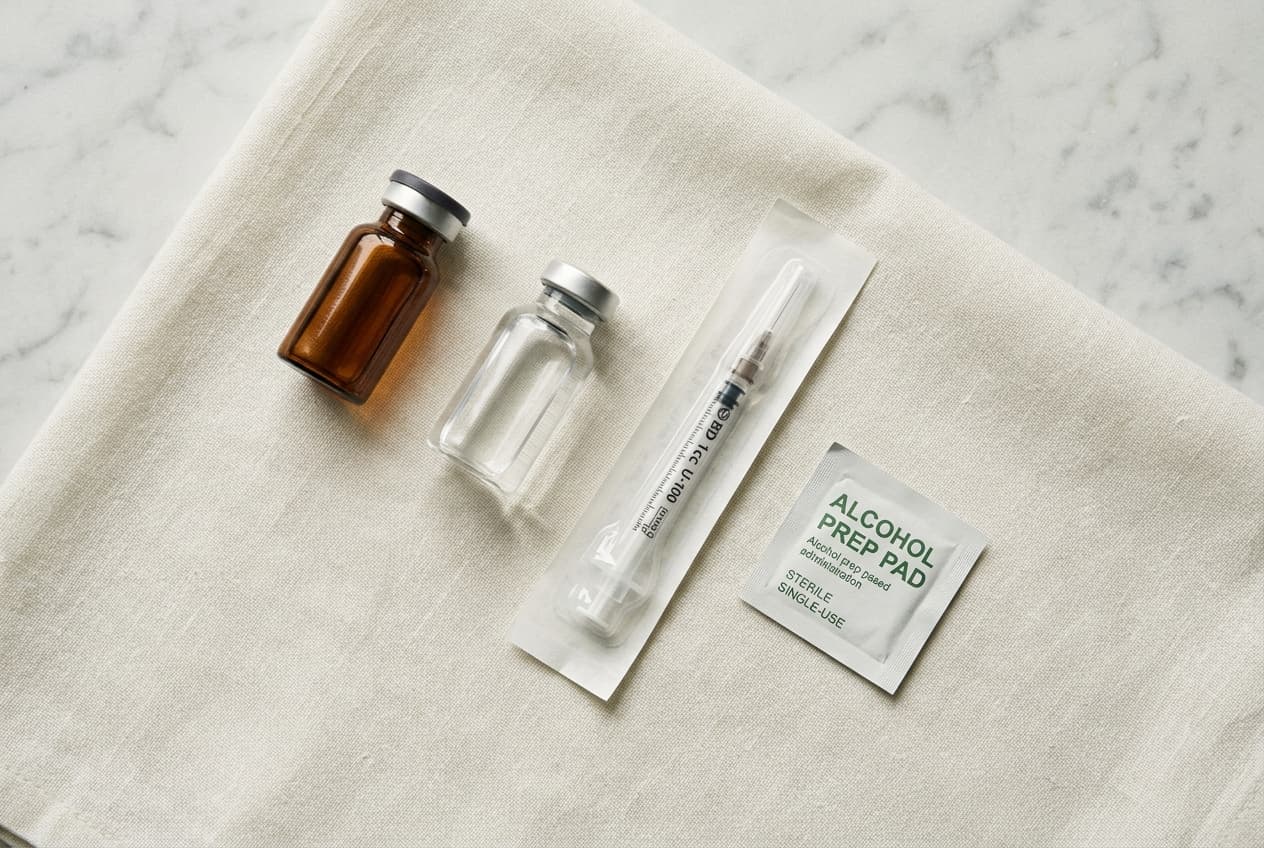
A 5 mg vial with 2 ml bacteriostatic water gives 2.5 mg/ml. A 100 mcg dose is 0.04 ml, which is 4 units on a U-100 insulin syringe; a 200 mcg dose is 8 units. Inject subcutaneously into the abdomen or thigh 30 to 60 minutes before bed, and rotate sites. The same patch of skin gets sore from nightly injections faster than people expect. Store the reconstituted vial in the fridge.
Open calculator pre-filledStorage after reconstitution
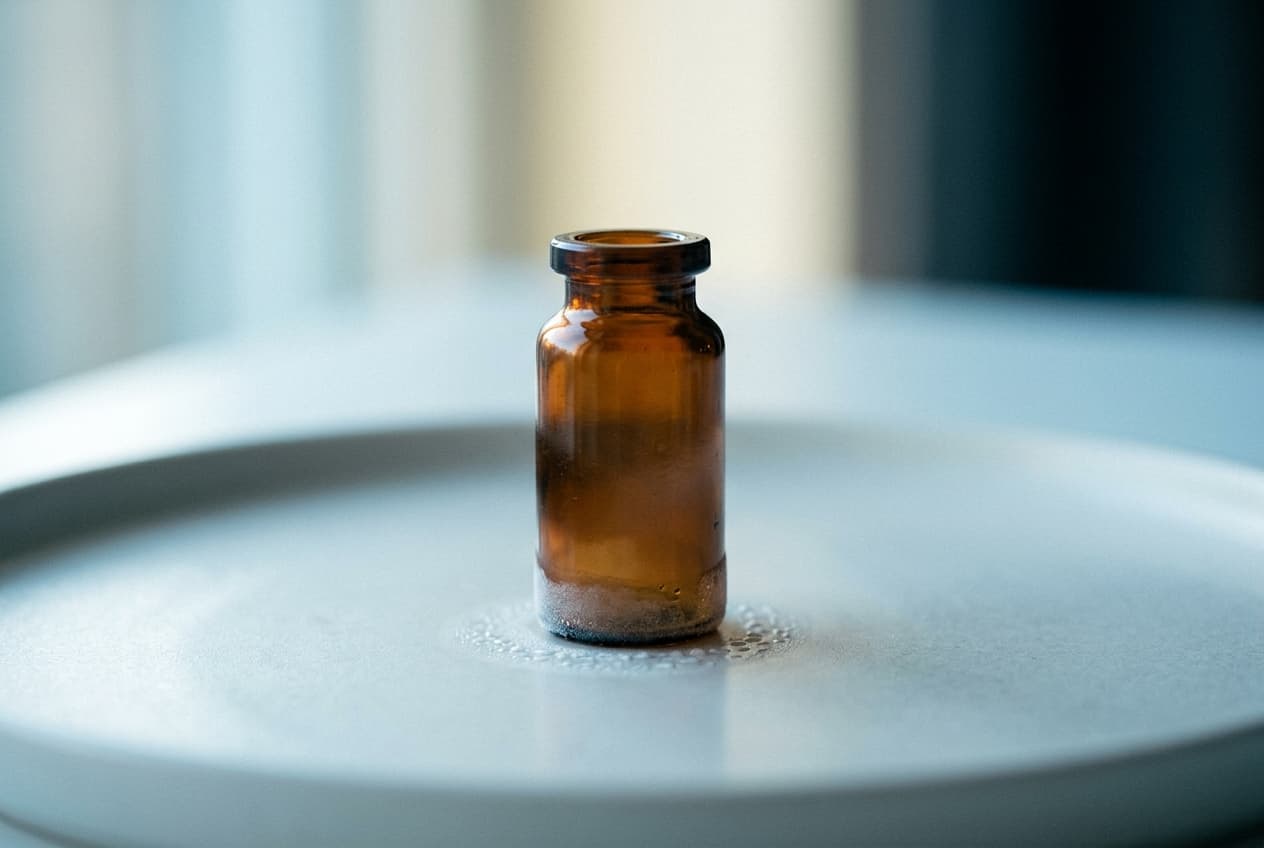
Refrigerate at 2 to 8 °C after reconstitution. Do not freeze. Light-protected. DSIP is one of the less-stable peptides in solution. Practical fridge window is 14 days. Because dosing is intermittent (only before sleep, often not nightly), mix smaller batches.
Cost & sourcing red flags
Typical price range: $25-45 per 5 mg lyophilised vial from US research-grade suppliers. A 30-day cycle at 100-300 mcg before bed runs $20-40 in raw material. Compounded prescription versions, when found, are $150-300 per month.
Red flags
- DSIP has effectively no modern human trial data: the last meaningful clinical work was published in the early 1990s. Any vendor or clinic marketing it as a 'proven sleep peptide' is selling 30-year-old preliminary findings as current evidence.
- Pre-mixed 'DSIP sleep stacks' that include unspecified amounts of GHRP-6, GHK-Cu, or melatonin. The DSIP content is often a token decoration; the actual sedative effect comes from the undisclosed co-ingredients.
- Single 5 mg vials priced under $15. DSIP is a 9-amino-acid peptide that is genuinely cheap to synthesise, but vials this cheap with no batch COA are commonly underdosed or repackaged from bulk lots of unknown provenance.
- Nasal-spray DSIP marketed as a substitute for injectable. DSIP has poor intranasal bioavailability in the small literature that exists; nasal product is not a known-equivalent route and may produce no measurable effect.
- Vendors claiming DSIP 'restores natural sleep architecture' or 'fixes delta-wave deficiency'. The original 1970s rabbit studies that produced the name have not been independently replicated in modern human polysomnography; the architecture claim is marketing extrapolation, not data.
Pricing rots fast and varies by region and supplier. We list no vendors.
Common mistakes
Dosing it like melatonin, hours before bed.
Better approach: DSIP has a short half-life and the effect lands within an hour. 30 to 60 minutes before lights-out is the right window. Earlier and you miss the peak; later and you get the peak after you have already drifted off, which defeats the purpose.
Escalating the dose when 100 mcg does nothing.
Better approach: Going to 200 or 500 mcg occasionally helps non-responders, but more often it produces the same null result with a fatter wallet hit. If two weeks at 200 mcg have not moved your sleep, DSIP is probably not your problem's answer.
Stacking it with a Z-drug or benzodiazepine "to make sure".
Better approach: The Z-drug will do most of the work and you will not be able to tell what DSIP is contributing. Run DSIP cleanly first; if it is not enough, the layered approach is a clinician's call, not a self-experiment.
Using it to mask a real sleep-apnoea or shift-work problem.
Better approach: If you snore heavily, wake unrefreshed despite 8 hours, or work nights, deepening sleep is downstream of the actual issue. Get a sleep study or fix the circadian misalignment first. DSIP on top of untreated apnoea makes the apnoea worse.
Real-world tips
- Use a wearable that scores sleep stages, even imperfectly. Subjective sleep-depth ratings drift; an objective delta or deep-sleep trend tells you whether the protocol is doing anything.
- Rotate injection sites nightly. Pick four spots (left/right abdomen, left/right thigh) and cycle through them. The soreness goes away.
- Pair with a dark room and a fixed bedtime. DSIP layered onto poor sleep hygiene rarely outperforms good sleep hygiene without DSIP.
- Refrigerate after reconstitution. Most users see no obvious potency loss over 3 to 4 weeks.
- If you wake with grogginess instead of feeling rested, halve the dose. Counter-intuitively, less DSIP is often more useful sleep.
What users report
Aggregated from r/Peptides, r/PeptidesHelp, and longecity sleep-stack threads. Not clinical data; DSIP has near-zero modern controlled human trials.
Onset: Subcutaneous dose 30-60 minutes before bed; users describe either a mild yawn-and-drift feeling 20-40 minutes after the shot, or nothing at all. The non-response rate is unusually high.
Common reports
- Slightly faster sleep onset on the nights it works, more 'felt sleepy' than 'knocked out.' Closer to a warm drink than to a Z-drug.
- More vivid dream recall, mentioned in roughly a third of user reports. Some users describe this as pleasant; others as disruptive enough to stop.
- Less middle-of-night waking, particularly for users whose baseline complaint was 3-4 am awakenings rather than sleep onset.
- A common minority report: paradoxical wakefulness or restlessness 1-2 hours after dosing, sometimes with mild tachycardia. Often pinned to dose >300 mcg.
- 'Felt nothing' is the single most common log entry. Estimates from forum polls hover at 40-60% non-response. Users frequently abandon it after a 1-2 week trial.
- No morning grogginess in responders, in contrast to high-dose melatonin or sedative antihistamines. This is the most-cited reason users keep trying it despite the inconsistent effect.
Where reports diverge from theory: DSIP was named for its alleged ability to induce delta-wave (slow-wave) sleep in rabbits. Modern user polysomnography from biohackers using consumer EEG headbands does not consistently show increased delta sleep; the felt effect, when it happens, is closer to anxiolysis than to deeper slow-wave sleep. The peptide may be working through a mechanism unrelated to its name, and the high non-response rate looks more like a placebo-amenable signal than a robust sleep-architecture intervention.
When something else is the better tool
Melatonin
Use instead when: Your problem is sleep onset, not sleep depth. Melatonin shifts the timing of falling asleep; DSIP targets quality once you are out. Many users pair them for the same reason.
CBT-I
Use instead when: The insomnia is chronic and behavioural. Cognitive behavioural therapy for insomnia has the strongest evidence base of any sleep intervention and outperforms most pharmacology over months. Do that first; layer peptides if a measurable gap remains.
Magnesium glycinate or low-dose trazodone
Use instead when: You want a cheaper, more available intervention with a longer safety track record. Both have real but modest effects and are sensible to try before DSIP.
Based on 1 peer-reviewed study
- Will DSIP make me fall asleep faster?
- Not reliably. The reported effect is on sleep depth, not onset. If onset is your main problem, melatonin or addressing the underlying anxiety is a better start.
- How do I know it's working?
- Hard to tell. Use a sleep tracker for a baseline week and the first two weeks of dosing; look at deep-sleep minutes and morning subjective rest. If neither moves, DSIP is not contributing.
- Can I dose every night long-term?
- No published safety problem with longer use, but no benefit data past a few months. 6 weeks on, 2 off, is a reasonable default.
- Why are the trials so old?
- The original delta-sleep hypothesis didn't replicate cleanly and pharmaceutical interest moved to GABAergic hypnotics and orexin antagonists, which had better-defined targets. DSIP became a research curiosity the grey market kept alive.
- Does the route matter. Could I take it orally?
- Oral peptides of this kind get destroyed by gastric protease. Stick to subcutaneous for any chance of bioavailability.
Last updated:
Related peptides
Other compounds in this category