

Melatonin
Also known as: N-acetyl-5-methoxytryptamine
The body's own sleep-onset hormone, sold as an over-the-counter supplement in most jurisdictions. Effective and cheap when used correctly. And chronically overdosed by almost everyone who uses it.
Overview
Melatonin is not really a peptide; it is a small indole hormone the pineal gland releases when the suprachiasmatic nucleus senses darkness. Supplemental melatonin works because it convincingly mimics that signal, telling the rest of the body that night has started. The useful evidence sits in two places: shifting the circadian clock for jet lag and shift work, and easing sleep onset in older adults whose endogenous production has dropped. The dose response is bizarre. Physiological doses (0.3 to 0.5 mg) raise serum levels into the natural range and work; 5 to 10 mg tablets push serum levels twenty-fold above natural and often produce morning grogginess without better sleep. The market sells the high-dose version because more sounds better, but the trial evidence and physiology both point the other way. It is approved as a prescription drug in some jurisdictions (Circadin in the EU) and a freely available supplement in most of the world.[1]
Evidence quality
Approved as a prescription drug (Circadin and others) in the EU for short-term insomnia in adults over 55, and sold OTC as a supplement in most of the world. The Cochrane reviews support short-term use for sleep onset, jet lag, and delayed sleep phase disorder. The trial base for high-dose long-term use is thinner than the marketing suggests. Most positive trials use 0.5 to 3 mg. Cite Auld 2017 and the 2017 BMJ jet-lag review as anchors.
Benefits & timeline
Benefits
- Faster sleep onset, especially in older adults or shift workers whose internal clock is misaligned
- Effective phase-shift tool for jet lag. Westbound and eastbound. When used at the destination evening for a few nights
- Antioxidant activity at the cellular level, although the clinical relevance of this outside of sleep is overstated in marketing
- Decades of safety data in adults at physiological doses, including in patients who have used it nightly for years
Timeline
Night 1
Faster time to sleep the same night, often by 10 to 20 minutes.
Week 1
Stable onset improvement. Sleep depth and morning rest are not the primary effect.
Week 4
The effect plateaus and may even attenuate if the dose has been too high. Many users notice the lower-dose version works better here.
Open-ended
Long-term nightly use is supported by the safety data, but periodic re-evaluation is sensible.
Dosage protocols
Advanced
10 mg
once nightly
High doses may cause grogginess; lower is often more effective.
Beginner
500 mcg
once nightly
Standard
3 mg
once nightly
Titration & adjustment
Counter-intuitively, less is more. Start at 0.3 to 0.5 mg pre-bed. Only escalate if sleep onset does not improve. Higher doses (3 to 10 mg) can paradoxically cause morning grogginess. For jet lag: 0.5 mg 30 minutes before target bedtime at the destination, for 3 to 5 nights. No taper required.
Injection timing

30 minutes before target bedtime. For jet lag, 30 minutes before target bedtime at the destination, NOT at the time you would normally sleep at the origin. Do not dose during the day. It shifts the circadian phase the wrong direction.
Side effects & contraindications

- mildVivid dreams or nightmares, especially at doses above 1 mg.
- mildMorning grogginess at higher doses. The most reliable sign that the dose is too high, not too low.
- mildHeadache, usually transient.
- mildHormonal modulation in adolescents. Pediatric use is a clinical decision, not a self-experiment.
Contraindications
- Pregnancy and breastfeeding. Limited controlled data, hormonal active substance
- Autoimmune disease in flare. Melatonin has immunomodulating activity and clinical effects in conditions like rheumatoid arthritis are unpredictable
- Children and adolescents without a clinician's guidance. The developmental safety data is incomplete
- Concurrent immunosuppressant or anticoagulant therapy. Manage with a pharmacist's eye
Reconstitution & injection
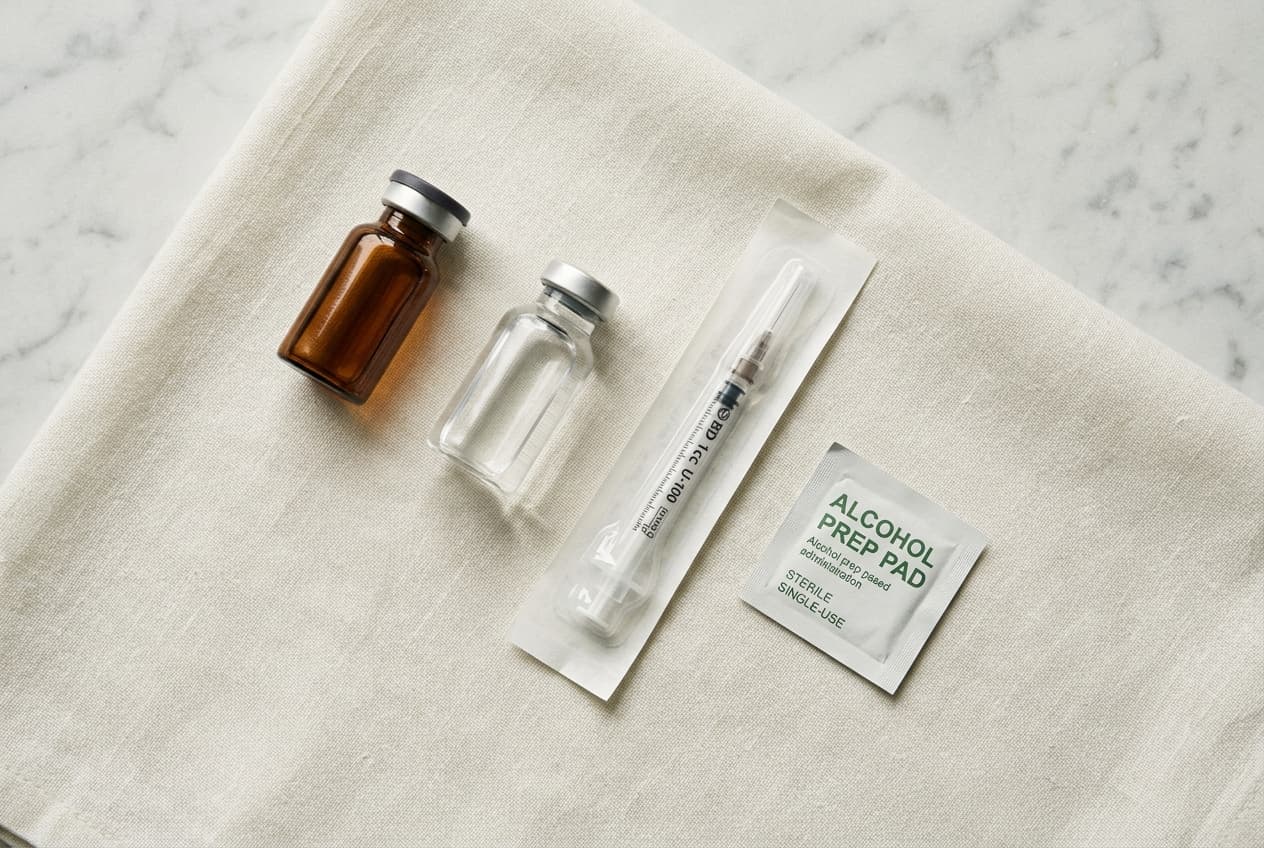
Oral tablets are the standard form and the only one most users will ever encounter. 0.3 mg, 0.5 mg, 1 mg, 3 mg, 5 mg, and 10 mg are widely available. Take 30 to 60 minutes before the target bedtime. The injectable form exists for niche research and clinical use: a 10 mg vial with 5 ml bacteriostatic water gives 2 mg/ml, and a 0.5 mg dose draws 0.25 ml. For nearly everyone, the tablet is the right choice and the lower strength is the right strength.
Open calculator pre-filledStorage after reconstitution
Subcutaneous melatonin: refrigerate at 2 to 8 °C after reconstitution. Light-protected (melatonin is photosensitive. Store in the original opaque vial or wrap in foil). Stable 28 to 30 days at fridge temperature. The crystalline form in solution can sometimes show very fine precipitate after cold storage. Warm gently in the hand to redissolve before drawing. Oral melatonin tablets: room temperature, sealed, light-protected, no fridge required.
Cost & sourcing red flags
Typical price range: $5-15 for a 60-90 day supply of 0.3-1 mg low-dose tablets from major US retailers; $8-20 for the same period of 3-10 mg products. Pharmaceutical-grade (Circadin 2 mg prolonged-release, EU prescription) runs $30-50 per month.
Red flags
- 10 mg and 'extra strength' gummies are routinely off-label. A 2017 Canadian study found actual content of 31 commercial melatonin products ranged from 17% to 478% of label; a 2023 JAMA study of US gummies found 22 of 25 products mislabelled, several containing CBD that was not disclosed.
- Chewables and gummies are the worst-variance form factor. The 2023 JAMA assay showed individual gummies from the same bottle varying by up to 347% from each other due to non-uniform mixing during manufacture.
- Products marketed at children with 5 mg or 10 mg per gummy. Even the upper-end physiological dose for an adult is under 1 mg; pediatric overdose calls to US poison control centers rose more than 500% between 2012-2021, almost entirely from gummy ingestion.
- 'Time-release' or 'extended-release' US supplements with no published dissolution data. The pharmaceutical extended-release product (Circadin) is matrix-engineered; supplement-grade versions often dump 80% of the dose in the first hour and offer no sustained release.
- Doses above 1 mg sold as a 'sleep aid.' The MIT and subsequent dose-response work consistently shows 0.3-0.5 mg matches or beats higher doses for sleep efficiency while avoiding the morning carryover that hits at 3+ mg.
- Products with no USP Verified, NSF, or ConsumerLab seal. The supplement category is unusually permissive about actual content; third-party verification is the only meaningful filter buyers have.
Pricing rots fast and varies by region and supplier. We list no vendors.
Common mistakes
Reaching for the 10 mg tablet because the 5 mg "stopped working".
Better approach: Higher doses do not work better and often work worse. The receptors desensitise and you end up with morning hangovers. Drop to 0.3 to 0.5 mg for a week. Most users find this works as well or better than what they were doing.
Using melatonin to fall asleep at a normal bedtime despite poor sleep hygiene.
Better approach: Melatonin is a circadian signal, not a sedative. If you are scrolling your phone at midnight in a bright room, the bright phone is overriding the melatonin. Dim lights, dark room, consistent schedule first.
Treating it as harmless because it is OTC.
Better approach: It is a hormone, not a vitamin. It has real interactions with anticoagulants, immunosuppressants, and hormonal contraceptives. The risk profile is friendly at low doses, but "friendly" is not "none".
Giving it to children for behaviour problems.
Better approach: Use in children, particularly with autism or ADHD, has a real clinical role, but it is a pediatrician's decision with dosing they will set. Self-prescribing to a kid because grandma had insomnia is a different category of decision.
Real-world tips
- Buy the 0.5 mg or 1 mg strength. If you can only find 3 mg or 5 mg, split the tablet. Less is more is almost always correct here.
- For jet lag eastbound, dose 30 minutes before the new local bedtime for 3 to 5 nights. Westbound, late-night arrival dosing also works but is less critical because westbound is easier.
- Pair with light. The strongest circadian tool is bright morning light at the destination. Melatonin in the evening plus light in the morning shifts the clock faster than either alone.
- If you wake at 3 AM regularly, this is a sleep-maintenance problem, not an onset problem. Standard melatonin is the wrong tool. Try a sustained-release formulation or rule out other causes.
- Stop using it for a few nights every couple of months as a check. If you sleep fine without it, you might not have needed the daily dose.
What users report
Aggregated from r/Sleep, r/Insomnia, r/Nootropics. Reflects the experience of a much larger user base than any of the other peptides in this set.
Onset: Most users describe feeling drowsy 30-60 minutes after dosing, but the more useful effect (faster sleep onset on subsequent nights) consolidates after 2-3 days of consistent same-time dosing.
Common reports
- Faster sleep onset for circadian-misaligned users: shift workers, jet-lagged travellers, and people with delayed sleep phase. Effect is far weaker for users with conditioned/anxiety insomnia.
- Vivid, sometimes uncomfortably intense dreams. Often the first thing users mention. More common at 3 mg+ doses and at the start of dosing.
- Morning grogginess and a 'hung-over' feeling at doses of 5 mg and above. This is the single most common reason users either downsize to 0.5-1 mg or stop entirely.
- Headaches in week 1 for some users, usually self-limiting. Less common at low doses.
- Loss of effect over 1-2 weeks of nightly use at higher doses, often blamed on 'tolerance' but more likely receptor downregulation. Cycling or dropping the dose restores response.
- A long-running pattern in user reports: dropping from 10 mg or 5 mg to 0.3-0.5 mg results in better sleep and zero grogginess. The most common 'lesson learned' in any melatonin thread is that less is more.
Where reports diverge from theory: Melatonin is a chronobiotic, not a sedative; its evidence base supports phase-shifting circadian timing more than promoting sleep on demand. Consumer marketing and user expectation have reframed it as a sleep aid, and most users dose at pharmacological levels (3-10 mg) when the published dose-response data supports 0.3-0.5 mg taken 4-6 hours before target sleep time for phase-shift, or at bedtime for sleep onset in older adults with low endogenous production. The popular high-dose-at-bedtime pattern is the worst of both worlds: too high for the chronobiotic effect, too late to phase-shift, and high enough to leave residual melatonin in circulation the next morning.
When something else is the better tool
DSIP
Use instead when: Your problem is sleep depth, not sleep onset. Melatonin shifts when you fall asleep; DSIP targets how deeply you sleep once there. Many users pair the two.
Sleep hygiene + light therapy
Use instead when: Your circadian misalignment is fixable behaviourally. Bright morning light and a dim evening do most of what melatonin does, for free, with less risk. Try this first.
Z-drugs or trazodone
Use instead when: Your insomnia is severe, chronic, and behavioural fixes have failed. These have stronger acute effects and a clinical framework around dosing and de-escalation. Melatonin is the wrong tool for clinically disabling insomnia.
Based on 1 peer-reviewed study
- What dose should I take?
- Start at 0.3 or 0.5 mg, 30 to 60 minutes before bed. Increase only if a week at the lower dose has not improved onset. Most users who think they need 5 mg are running a high-dose protocol that is producing morning grogginess they have not connected to the dose.
- Is it safe to take every night long-term?
- At physiological doses (0.3 to 1 mg), the safety data extends over years of nightly use in adults. At higher doses, the safety record is less mature. Periodic breaks let you check whether you still need it.
- Will it suppress my body's own production?
- Short-term use does not appear to durably suppress endogenous melatonin production. Long-term high-dose data is less clean, which is another reason to stay at lower doses.
- Best for jet lag?
- Yes, with the right protocol: 0.5 mg 30 minutes before the new local bedtime for 3 to 5 nights, paired with bright morning light at the destination. This is one of the strongest evidence-based uses.
- Is it a peptide?
- No. It is an indole hormone. Small molecule, not a protein. We include it because the sleep-stack overlaps with the peptide world and users routinely pair it with DSIP and others.
Last updated:
Related peptides
Other compounds in this category