

SS-31 (Elamipretide)
Also known as: Elamipretide · MTP-131 · Bendavia
A four-amino-acid peptide that homes to the inner mitochondrial membrane and stabilises cardiolipin. Currently the most clinically advanced mitochondrial peptide in trials.
Overview
SS-31 (elamipretide, formerly Bendavia) is unusual among 'longevity' peptides in that it has a clear biophysical mechanism and a real clinical-trial pipeline. The peptide concentrates in the inner mitochondrial membrane by an unusual electrostatic mechanism and binds cardiolipin, the phospholipid that organises the electron transport chain. Stabilising cardiolipin tightens the chain, reduces electron leak, and cuts reactive-oxygen-species production at source. Phase 2 trials in Barth syndrome, primary mitochondrial myopathy, and dry AMD have shown signal but not approval-grade effect sizes; the programme continues. Outside trials, users dose for general mitochondrial-energy improvement and report subjective gains that are hard to measure objectively.[1]
Evidence quality
Multiple Phase 2 trials have been completed and ongoing in Barth syndrome (TAZPOWER), primary mitochondrial myopathy (MMPOWER series), and dry age-related macular degeneration (ReCLAIM). Effect sizes have been mixed. Clear pharmacodynamic signal, less consistent clinical-endpoint improvement. The 2014 Szeto group review established the mechanism. Stealth BioTherapeutics has been the primary sponsor. No approved indication yet, but the regulatory dossier is the most developed in the mitochondrial-peptide space.
Benefits & timeline
Benefits
- Mitochondrial-targeted antioxidant effect via cardiolipin binding. Operates at the source of ROS production rather than scavenging downstream
- Subjective energy improvements, particularly in users with age-related mitochondrial decline
- Active development pipeline for Barth syndrome and mitochondrial myopathy. The closest thing to a 'real' mitochondrial drug
- Cardiac and renal protective signals in animal ischemia-reperfusion models
Timeline
Week 1
Most users feel nothing yet. Mitochondrial turnover is slow and the signal accumulates rather than spikes.
Week 2 to 3
Subjective energy and recovery improvements begin. Particularly mid-afternoon, when mitochondrial function tends to be the rate-limiter for older users.
Week 6 to 8
If anything is going to work, it's clear by here. Objective metrics (exercise tolerance, HRV, time-to-fatigue on familiar workouts) are the honest read.
Week 12
Plateau. Continuing past 12 weeks rarely improves the response further.
Off-cycle
4 weeks off lets you read whether the gains hold without ongoing dosing. Many users find a fraction of the benefit persists, suggesting the mitochondrial pool got 'cleaner' even after stopping.
Dosage protocols

Advanced
5 mg
once daily
Beginner
1 mg
once daily
Standard
3 mg
once daily
Titration & adjustment
Start at 1 mg once daily for the first week. Escalate to 3 mg once daily for the rest of the cycle if energy improvement is felt. Maximum 5 mg daily. Cycle off for 4 weeks every 12 weeks to allow for objective re-assessment.
Injection timing

Once daily, morning preferred. Energy improvements feel most useful when dosed early in the day.
Side effects & contraindications

- mildInjection-site reaction. Small bump or redness for under 24 hours.
- mildHeadache in the first few days, usually resolving on its own as the dose is held steady.
- mildTransient nausea at higher doses (5 mg), particularly on an empty stomach.
- moderateLong-term safety data is still being generated through the Phase 2 trials. Years of dosing have not flagged major issues, but the safety envelope is narrower than for fully approved drugs.
Contraindications
- Active cancer. Tumours rely on mitochondrial metabolism too, and a peptide that protects mitochondrial function may be doing the wrong thing in this context
- Pregnancy or breastfeeding. No human reproductive data
- Severe renal impairment without specialist guidance, given the clearance route
- No pediatric data outside the Barth-syndrome trials, which are conducted under specialist supervision
Reconstitution & injection
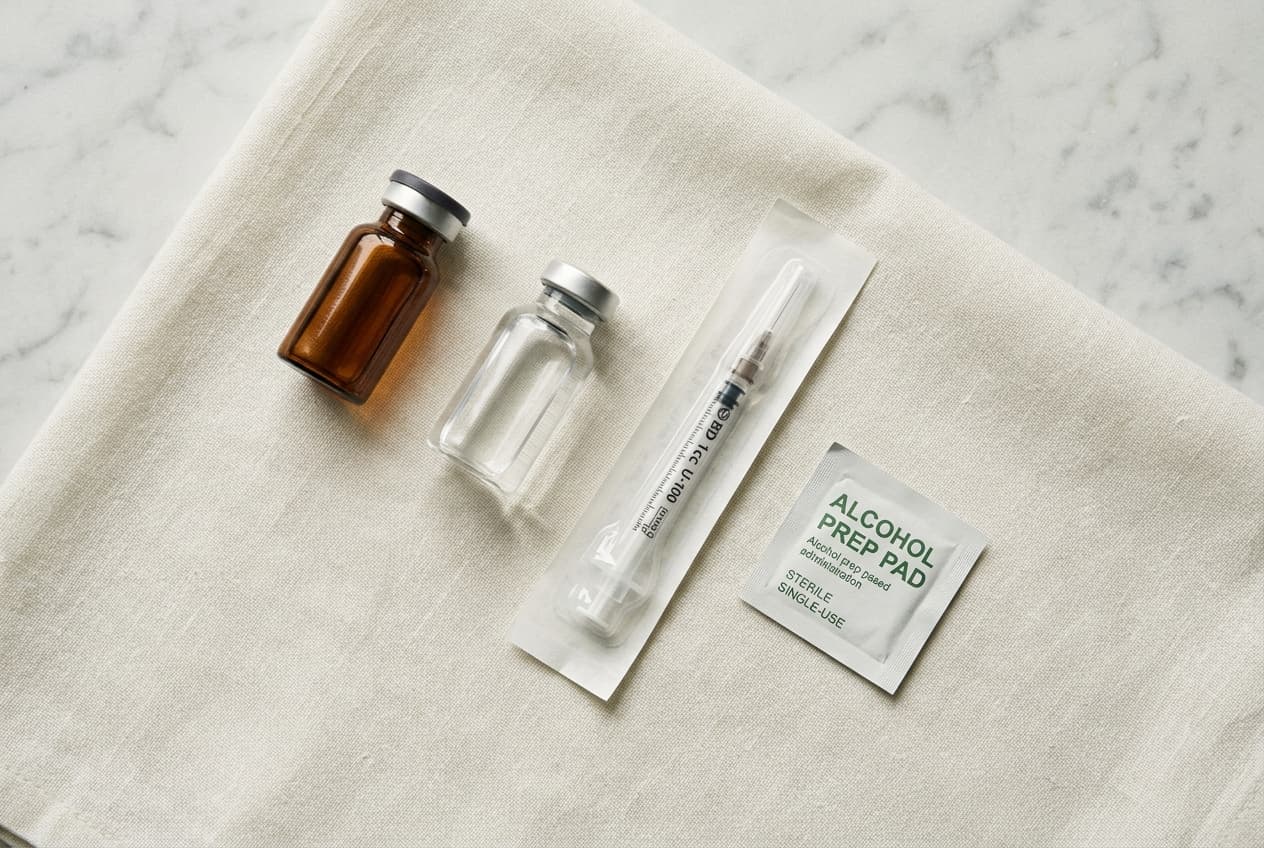
A 10 mg vial reconstituted with 2 ml bacteriostatic water gives 5 mg per ml. A 3 mg dose is 0.6 ml, which is 60 units on a U-100 insulin syringe; a 1 mg dose is 20 units, a 5 mg dose is 100 units (the full insulin syringe. Use a 1 ml syringe if available). Subcutaneous into abdomen or thigh; rotate sites. The peptide is reasonably stable in solution but refrigerate after reconstitution and use within 30 days. Morning dosing is the convention because the energetic effect is most usefully felt early in the day.
Open calculator pre-filledStorage after reconstitution

Refrigerate at 2 to 8 °C after reconstitution. Do not freeze. Light-protected. SS-31 (elamipretide) reconstituted in BAC water is stable for 28 days at fridge temperature. The molecule targets cardiolipin in the inner mitochondrial membrane and is reasonably robust in solution.
Cost & sourcing red flags
Typical price range: Two parallel markets. Brand-name elamipretide (Forzinity, Stealth BioTherapeutics, FDA-approved September 2025 for Barth syndrome) is priced as an ultra-rare-disease drug, typically $200,000+ per year through specialty pharmacy. Research-grade SS-31 runs $60-150 per 5 mg or 10 mg vial; a 4-week subcutaneous protocol at 5-10 mg per day uses 2-4 vials and costs $120-600 in raw material.
Red flags
- 10 mg vials priced under $40. SS-31 is a 4-residue peptide with a non-standard arginine derivative (Dmt), and the synthesis is more expensive than typical research peptides; reputable lots floor out near $60 for 10 mg. Below $40 the supplier is usually using a cheaper substitute sequence or underdosing.
- No mass-spectrometry on the COA confirming the 639.8 g/mol parent ion. SS-31 contains 2,6-dimethyltyrosine, an uncommon residue that distinguishes it from cheaper tetra-peptides; HPLC alone does not confirm the Dmt is present.
- Vendors who conflate SS-31 with SS-02 or SS-20. These are related Szeto-Schiller analogues with different cardiolipin-binding affinities, and some suppliers mislabel the cheaper variants as SS-31. The specific sequence (D-Arg-Dmt-Lys-Phe-NH2) must be stated on the COA.
- Pricing identical to commodity peptides like BPC-157 or TB-500 from the same vendor. SS-31 is meaningfully more expensive to make, and price parity with cheaper peptides is a red flag for a substituted product.
- Vials shipped at ambient temperature without cold-pack, especially in summer. Lyophilisate is stable in transit but research-grade suppliers who skip the cold pack typically also skip the cold-chain storage upstream.
- Claims that research-grade SS-31 is 'the same as Forzinity'. The clinical product is supplied as a buffered solution under cold-chain with strict identity testing; research-grade powder is the same molecule but is not interchangeable with the regulated product for clinical use.
Pricing rots fast and varies by region and supplier. We list no vendors.
Common mistakes
Expecting a stimulant-like jolt.
Better approach: SS-31 is not caffeine. The effect is a gradual lift in the energetic floor over weeks, not a same-day boost. If you're benchmarking against a pre-workout, you'll dismiss the peptide before it has time to work.
Dosing in the evening to 'support recovery.'
Better approach: Most users find the energetic effect mild but noticeable enough that late dosing disrupts sleep onset. Morning is the default for a reason. If recovery is the goal, the daytime effect on training capacity matters more than the bedtime timing.
Stacking with high-dose antioxidants.
Better approach: Heavy oral antioxidant doses (high-dose vitamin C, NAC) may blunt the exercise-adaptation signal that SS-31's milder ROS modulation preserves. The peptide operates at the source; ramming in scavengers downstream tends to be redundant or counterproductive.
Tracking it on energy alone.
Better approach: Energy is subjective and drifts. Pick an objective marker. Time-to-fatigue on a familiar steady-state effort, HRV trend over 2 weeks, recovery time between hard sessions. If those don't move by week 6, the peptide isn't doing what you hoped.
Real-world tips
- Morning dosing pairs well with fasted cardio. The mitochondrial substrate-handling effect is most usefully felt during fat-oxidation work.
- Reconstituted vials hold well at fridge temperature for 30 days. Don't freeze. The peptide tolerates 2 to 8°C but the unfolding from a freeze cycle is hard to detect visually.
- If you train heavily and notice the gains plateau at week 6, that's likely the ceiling for your current mitochondrial pool. Pushing the dose higher rarely helps.
- Pair with mitochondrial-stress training (zone-2 endurance, sprint intervals). The peptide protects mitochondria, but you still need to give them a reason to upregulate. SS-31 isn't a substitute for the work.
- Track HRV (chest strap, not wrist) over a 4-week baseline before starting. The most reliable signal SS-31 sends is a small but durable HRV improvement, and you can't see it without a baseline.
What users report
Aggregated from r/Peptides, longevity-focused forum threads, and mitochondrial-disease patient groups. Reporting pool is smaller than mainstream peptides and skewed toward older users running longevity protocols. Not clinical data.
Onset: Subjective endurance changes show up at 2-4 weeks of daily subcutaneous dosing; the older-adult mitochondrial-function trial (Conley et al., UW) measured biochemical changes after 3 weeks of treatment.
Common reports
- Longer sustained mental focus during prolonged work, described as 'I get to hour 3 without hitting the usual wall'. The most consistent subjective report.
- Faster between-set recovery during resistance training, with no felt acute effect on lift performance.
- Reduced perceived effort on cardio at the same heart rate during weeks 3-6.
- No felt acute hit on injection. Users new to peptides often discontinue early because there is nothing to feel for the first 1-2 weeks.
- Mild injection-site redness or itch at the subcutaneous site, similar to other 4-residue peptides.
- Occasional reports of darker urine in the first few days of dosing, attributed to the peptide's intrinsic colour rather than any pathology.
Where reports diverge from theory: SS-31 binds cardiolipin in the inner mitochondrial membrane and the mechanism predicts measurable improvements in mitochondrial respiration with limited acute felt effects. Forum reports of 'energy bump within hours' or 'feels like a stimulant' are inconsistent with the mechanism and almost certainly placebo or misattribution. The honest signal is slow, accumulative, and shows up in week-3+ endurance rather than week-1 buzz; users who chase an acute effect typically drop the protocol before the real effect lands.
When something else is the better tool
MOTS-c
Use instead when: Metabolic and exercise-capacity focus rather than direct membrane stabilisation. MOTS-c acts through a different mitochondrial axis (mitochondrial-encoded peptide signalling) and is the better fit if metabolic flexibility is the primary target.
NAD+ precursors (NMN, NR) or NAD+ injections
Use instead when: Substrate-pool depletion is the suspected bottleneck rather than membrane damage. Cheaper, oral options exist for NAD+; SS-31 is the right pick when the question is membrane integrity, not coenzyme supply.
Standard zone-2 training
Use instead when: You haven't yet done the boring work of building mitochondrial density through endurance training. The peptide protects what you have; it doesn't substitute for not having built it. Run a 12-week zone-2 block first, then re-evaluate.
Based on 1 peer-reviewed study
- Is SS-31 a longevity drug?
- Mechanistically it touches a longevity-relevant pathway (mitochondrial integrity drops with age, contributes to a long list of age-related diseases). Whether that translates to a measurable lifespan effect in humans is unknown. There is no longevity trial. Take the longevity framing as plausible mechanism, not demonstrated outcome.
- Why is it called both SS-31 and Elamipretide?
- SS-31 is the research designation from the original Szeto group; Elamipretide is the generic name assigned for clinical development. They are the same molecule. MTP-131 and Bendavia were earlier development names. The label drift is messy but the peptide is one.
- Will I feel it on day one?
- Almost certainly not. The mechanism is membrane stabilisation, not receptor activation. The signal accumulates over days to weeks. If you feel something dramatic on day one, that's likely either placebo or an irritation reaction.
- Can I stack with CoQ10?
- Yes. They operate on adjacent layers of the same system. CoQ10 supplies a redox-active substrate within the electron transport chain; SS-31 stabilises the membrane that organises it. Many users on mitochondrial protocols run both, alongside zone-2 work.
- What about hair, skin, or weight effects?
- Not the right peptide. SS-31 acts at the cellular energetics level; visible cosmetic effects are not its target. Users sometimes report skin-quality improvements as a secondary effect of better cellular energy, but if cosmetics are the primary goal, look at GHK-Cu or the GLOW/KLOW stacks instead.
Last updated:
Related peptides
Other compounds in this category
- EpithalonA Khavinson-school tetrapeptide (Ala-Glu-Asp-Gly) marketed for telomere lengthening and pineal regulation. The telomere claim rests on small Russian studies; the sleep effect is the more honest reason people use it.
- NAD+Technically a coenzyme rather than a peptide. Central to energy metabolism, DNA repair, and sirtuin activity. Levels fall with age; injectable and IV protocols try to restore them.
- MOTS-cA 16-amino-acid peptide encoded inside the mitochondrial genome. The cell's own metabolic stress signal. Animal data on insulin sensitivity is good; human data is small but growing.
- FOXO4-DRIThe headline senolytic peptide. It disrupts the FOXO4-p53 interaction inside senescent cells, pushing them into apoptosis while sparing healthy cells. Striking in mice, untested in humans.
- AICARAn AMPK activator that turns on the molecular pathway exercise normally activates. Famous as the "exercise in a syringe" rodent paper and infamous as a WADA-banned substance.