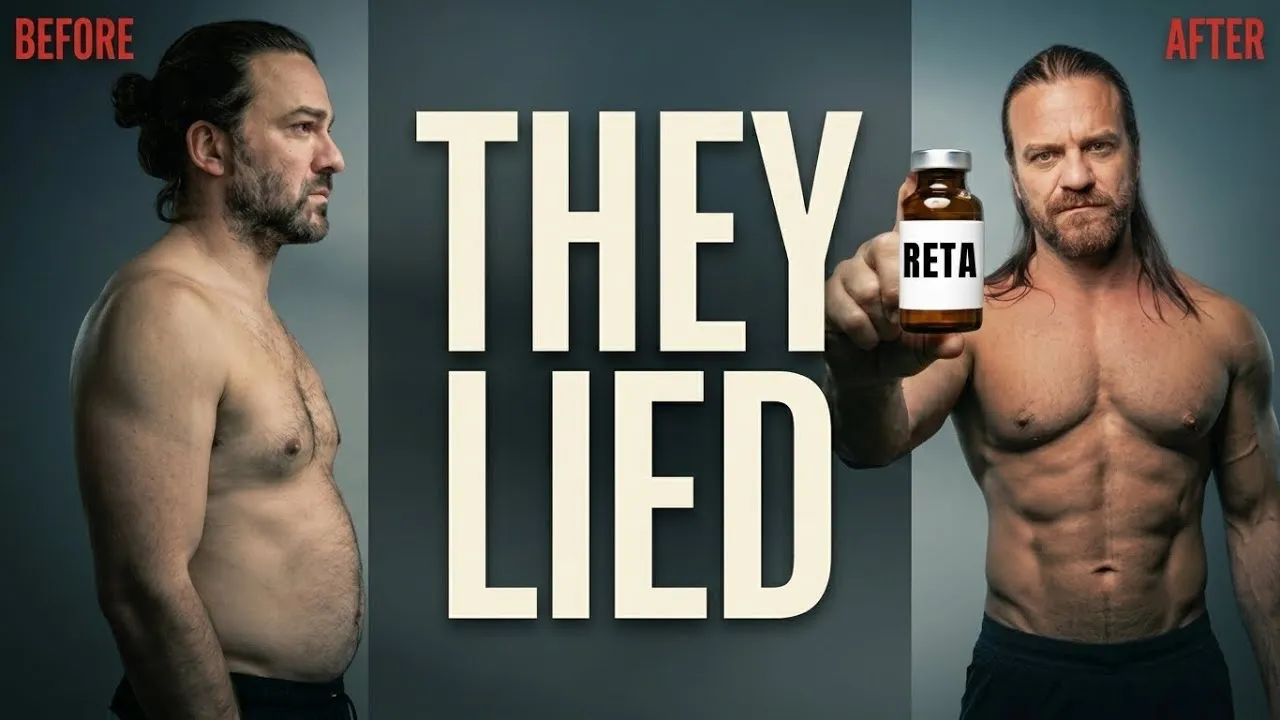
Retatrutide Stack: The Peptides That Fill the Gaps
A doctor explains which peptides fill the gaps in a retatrutide stack, the order that actually matters, and the combinations to avoid for weight loss.
Most advice on building a retatrutide stack reads like a shopping list: add this, add that, hope something sticks. In a recent video, Dr. Jones, DC, a coach who works alongside a prescribing medical team, argues that the list approach misses the point. His clinic uses a framework instead. Fat loss runs on three systems that have to work together: appetite control, fat mobilization, and metabolic enhancement. The question is never "what is the strongest thing to add." It is "which system is missing." This article walks through how he applies that idea to retatrutide, which peptides he layers on top, and the combinations he tells people to avoid.
Why retatrutide stalls for some people
Retatrutide is the first triple agonist to reach phase-three trials. It acts on three hormone receptors at once: GLP-1, GIP, and glucagon. Every approved GLP-1 medication works on one or two of these. The glucagon receptor is what sets retatrutide apart, because glucagon signals the liver to release stored energy and helps the body break down stored fat. Tirzepatide does not touch glucagon, and semaglutide touches neither glucagon nor GIP. In the TRIUMPH-4 trial, Dr. Jones notes, the highest dose produced 28.7% total body weight loss over 68 weeks.
So on fat mobilization, retatrutide is in a class of its own. The trade-off is appetite control. In his clinic, Dr. Jones says some patients get strong appetite suppression from retatrutide and others get very little. When the food chatter returns, people eat a bit more without noticing, the calorie deficit shrinks, and the scale stops moving. He is blunt about the ground rule: a calorie deficit beats any medication, no matter how powerful the molecule is.
He also flags a safety signal. At higher doses, roughly 21% of trial participants reported dysesthesia, a tingling or numbness sensation, and the rate appears to climb in phase three. His clinical response is to start low and stay on the lowest effective dose for as long as possible. Retatrutide is not yet approved, and he treats it with corresponding caution.
The three peptides that fill the gap
Once the appetite picture is understood, Dr. Jones layers three compounds to support systems two and three. The order, he stresses, matters as much as the choices.
AOD9604 comes first. It is a fragment of human growth hormone aimed at fat mobilization, without the blood-sugar or water-retention baggage he says most people fear. His key distinction: AOD mobilizes fat, it does not burn it. Picture fat cells as a locked vault, with insulin resistance as the lock. AOD is a key that opens the vault and releases fat into the bloodstream. If there is no calorie deficit to burn it, the fat goes back into storage. That, he argues, is why thin clinical research on AOD undersells it; his clinic pairs it with structured fasting so the mobilized fat is actually burned. Over three to four months, he reports fat loss becoming more consistent.
SLU-PP-332 resets the engine. Dr. Jones calls SLU-PP-332 an exercise mimetic, a compound that switches on some of the energy-burning pathways that hard aerobic exercise triggers. He frames it as "marathon mode" for the mitochondria, useful for patients who cannot train hard because of injury, fatigue, or recovery, and for trained patients during a metabolic reset. The mechanism he points to is mitochondrial uncoupling: cells burn fuel less efficiently on purpose, wasting energy as heat instead of storing it.
O304 accelerates. The third compound is technically a small molecule rather than a peptide, and it comes as a pill. Dr. Jones describes it as an AMPK activator, flipping the cell's metabolic master switch from "store" to "burn." He cites phase-two human data showing favorable metabolic markers and an encouraging safety profile, which he contrasts with the animal-only evidence behind much of the field. His warning: O304 is an accelerator, not a foundation. Used during a deep calorie-restricted reset, he says it can work against the process. The sequence he recommends is mobilize, reset, accelerate, in that order.
The combination the forums say to avoid
The combination Dr. Jones is most vocal about is low-dose retatrutide with low-dose tirzepatide. Online forums often call this redundant, "two hammers for one nail." He disagrees, and the reasoning comes straight from the three-system framework. Retatrutide's strength is fat mobilization through glucagon; its weakness is appetite. Tirzepatide is the reverse, and in his clinic it is the most effective tool for shutting down food chatter, while it cannot do what retatrutide does for fat mobilization.
Combined at low doses, he argues, you are not doubling up. You are using a hammer and a screwdriver: tirzepatide handles appetite, retatrutide handles fat mobilization, and you sidestep the high-dose side effects that drove dropouts in the trials. The forum argument, he says, assumes both drugs run at full dose. He is careful to add that this is not a do-it-yourself protocol. It needs precise dosing, blood work, and monitoring, which is also why he treats unapproved retatrutide differently from a medication someone might run on their own out of necessity. If you want to model reconstitution and volumes, the dose calculator is a starting point, but the dosing itself belongs with a clinician.
Combinations to stay away from
Two stacks he keeps seeing concern him. The first is phentermine with retatrutide. Phentermine is a stimulant, and retatrutide already raises heart rate in a mild, dose-dependent way, more than semaglutide or tirzepatide. Adding a stimulant stresses the cardiovascular system from two directions at once. The second is high-dose yohimbine with any GLP-1, for the same heart-rate and blood-pressure reasons.
He closes on sourcing. Retatrutide is a single complex chain peptide conjugate. Standard lab tests like HPLC and mass spectrometry can confirm molecular weight but not that the amino acids are in the correct order. The FDA has documented seizures of products containing heavy metals, endotoxins, and the wrong sequences. Third-party testing, a certificate of analysis, and supplier reputation, he says, matter a great deal.
What the evidence says
It is worth separating two kinds of claim here. The trial figures, the 28.7% weight loss, the 68-week window, the roughly 21% dysesthesia rate, and the modest heart-rate increases, come from retatrutide's clinical program. The stacking protocols are clinical observation from one practice, not controlled trials. AOD9604, SLU-PP-332, and O304 have not been studied as a retatrutide stack in humans, and O304's phase-two data covers metabolic markers rather than this combination. That gap is exactly why monitoring matters, and why anecdote should not be read as proof. For broader context on the goal, the fat-loss category collects the relevant monographs.
Key takeaways
- Dr. Jones treats fat loss as three systems: appetite control, fat mobilization, and metabolic enhancement. A stall usually means one system is missing.
- Retatrutide is strongest at fat mobilization through the glucagon receptor and weakest at appetite control, which is where stalls tend to appear.
- His layering order is AOD9604 to mobilize, SLU-PP-332 to reset the mitochondria, then O304 to accelerate once the foundation is set.
- Low-dose retatrutide plus low-dose tirzepatide is, in his clinic, a hammer-and-screwdriver pairing rather than a redundant one.
- Phentermine and high-dose yohimbine stacked with retatrutide raise real cardiovascular concerns, and unverified sourcing is its own risk.
- Trial numbers are evidence; clinic protocols are observation. The two are not the same.
This article is based on "Doctor Explains What to Stack with Retatrutide To MAXIMIZE Weight Loss" by Dr. Jones, DC. Source: https://www.youtube.com/watch?v=NdGKQ4aH7hI
This article is for educational purposes only. The peptides discussed are research compounds, and nothing here is medical advice. Always consult a qualified healthcare professional before making decisions about your health.
Source: YouTube