
Sermorelin
Also known as: Sermorelin Acetate · GRF 1-29
The oldest GHRH analogue still in widespread use. The first 29 amino acids of natural GHRH, unmodified. Pulses the pituitary in line with the body's natural sleep-onset GH window.
Overview
Sermorelin is GRF(1-29), the active fragment of human GHRH, no substitutions, no stabilising tricks. It had FDA approval for paediatric GH deficiency until 2008, when it was withdrawn for commercial reasons, not safety or efficacy. That history matters: this is one of the few peptides in the secretagogue family that actually cleared a regulatory bar. The pharmacology is the gentlest in the GHRH category. Half-life is short (10 to 20 minutes), the pulse is brief and physiologic, and dosed pre-bed it lands in the same window the pituitary would normally fire its own GH pulse. The lightest pharmacological intervention that still does something useful. The right choice for some users, the wrong one for others.[1]
Evidence quality
Sermorelin held FDA approval for paediatric GH deficiency from 1997 to 2008, when it was withdrawn from the US market for commercial, not safety or efficacy, reasons. The paediatric trial base is real and was good enough to clear regulatory review. Adult body-recomposition and anti-aging use is off-label and supported by smaller open-label work and the on-label pharmacology rather than a dedicated RCT base in healthy adults. The chronic safety record is reassuring across 25+ years of clinical and grey-market use.
Benefits & timeline
Benefits
- Restores age-related decline in the natural overnight GH pulse
- Sleep depth improves within the first week of pre-bed dosing
- Gradual recovery, skin, and body-composition improvements over months
- Side-effect profile cleaner than any GHRP and most other GHRH analogues
Timeline
Week 1 to 2
Sleep deepens. The overnight pulse lands at the right time and people notice it on waking.
Week 4 to 6
Subtle recovery improvements. Skin tone often shifts before body composition does.
Week 8 to 12
Body composition begins to move, slowly. Sermorelin is not a fast peptide. The timeline is months, not weeks.
Week 12+
Plateau. Cycle off for 4 weeks to refresh pituitary responsiveness.
Off-cycle
Four weeks off restores GHRH-receptor sensitivity. Sermorelin holds up well to repeated cycles because the underlying mechanism is so close to native physiology.
Dosage protocols
Advanced
300 mcg
once nightly
Beginner
100 mcg
once nightly
Standard
200 mcg
once nightly
Titration & adjustment
Start at 100 mcg once nightly. After 2 weeks, increase to 200 mcg nightly if you want a deeper GH pulse. Maximum 300 mcg nightly. No daytime dosing. Sermorelin works best aligned with the body's natural sleep-onset GH pulse. Cycle off for 4 weeks every 12 weeks.
Injection timing
Once nightly, 30 minutes before bed, on an empty stomach. Sermorelin works best aligned with the body's natural sleep-onset GH pulse. Daytime dosing wastes most of the effect.
Side effects & contraindications

- mildBrief facial flushing post-injection.
- mildInjection-site soreness or a small bump for 24 hours.
- mildMild headache in the first week for some users. Usually fades.
Contraindications
- Active cancer or recent cancer history. IGF-1 elevation is the mechanism to avoid
- Pregnancy or breastfeeding
- Severe primary pituitary failure. Sermorelin works by stimulating the pituitary, so a pituitary that cannot respond is not the right target
- Patients on supraphysiologic glucocorticoids. The steroid signal blunts the GH axis Sermorelin is trying to wake up
Reconstitution & injection
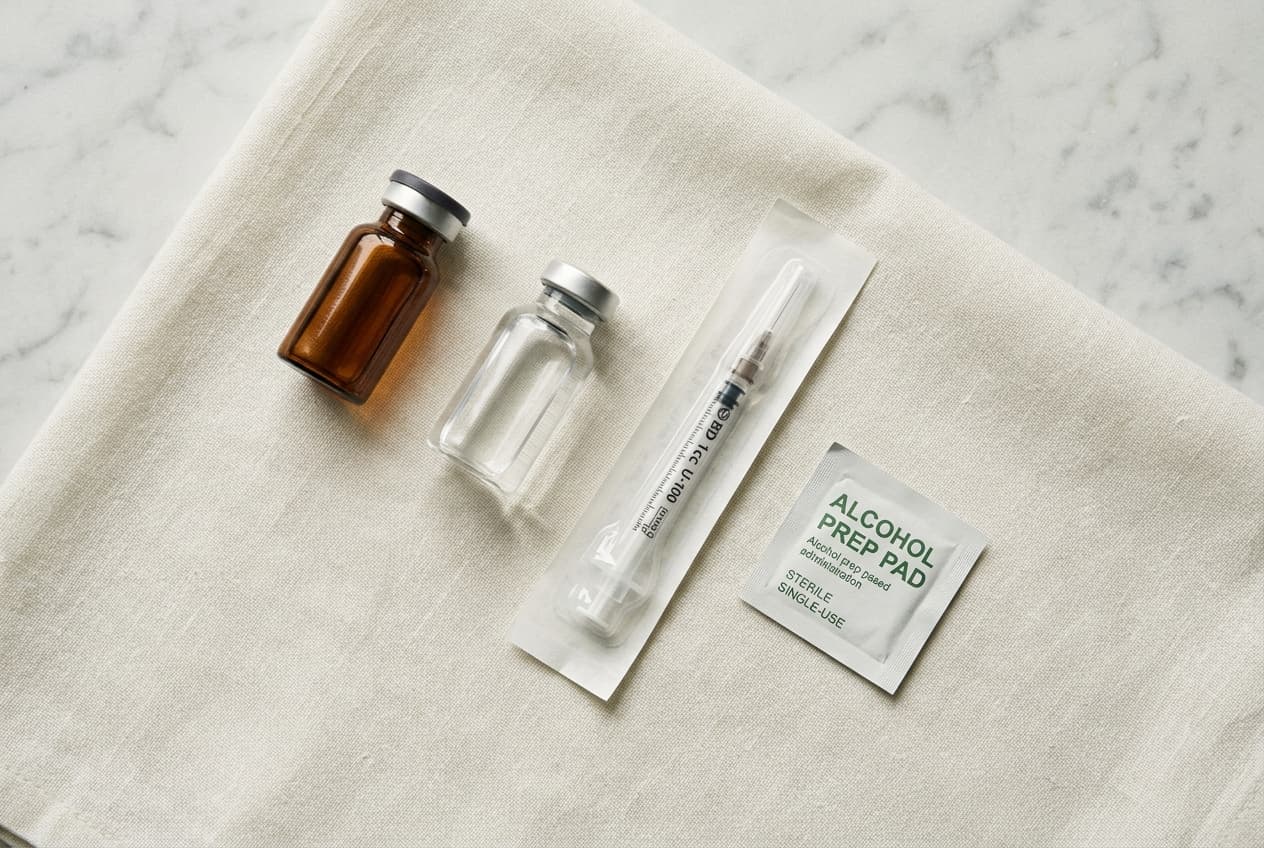
A 5 mg vial mixed with 2 ml bacteriostatic water gives 2.5 mg/ml. A 200 mcg dose is 0.08 ml. 8 units on a U-100 insulin syringe. A 100 mcg starting dose is 4 units. Subcutaneous abdomen or thigh, pre-bed on an empty stomach, with the 30-minute food-free window on either side. The short half-life means the timing matters: dose 20 to 30 minutes before lights-out, not an hour before.
Open calculator pre-filledStorage after reconstitution
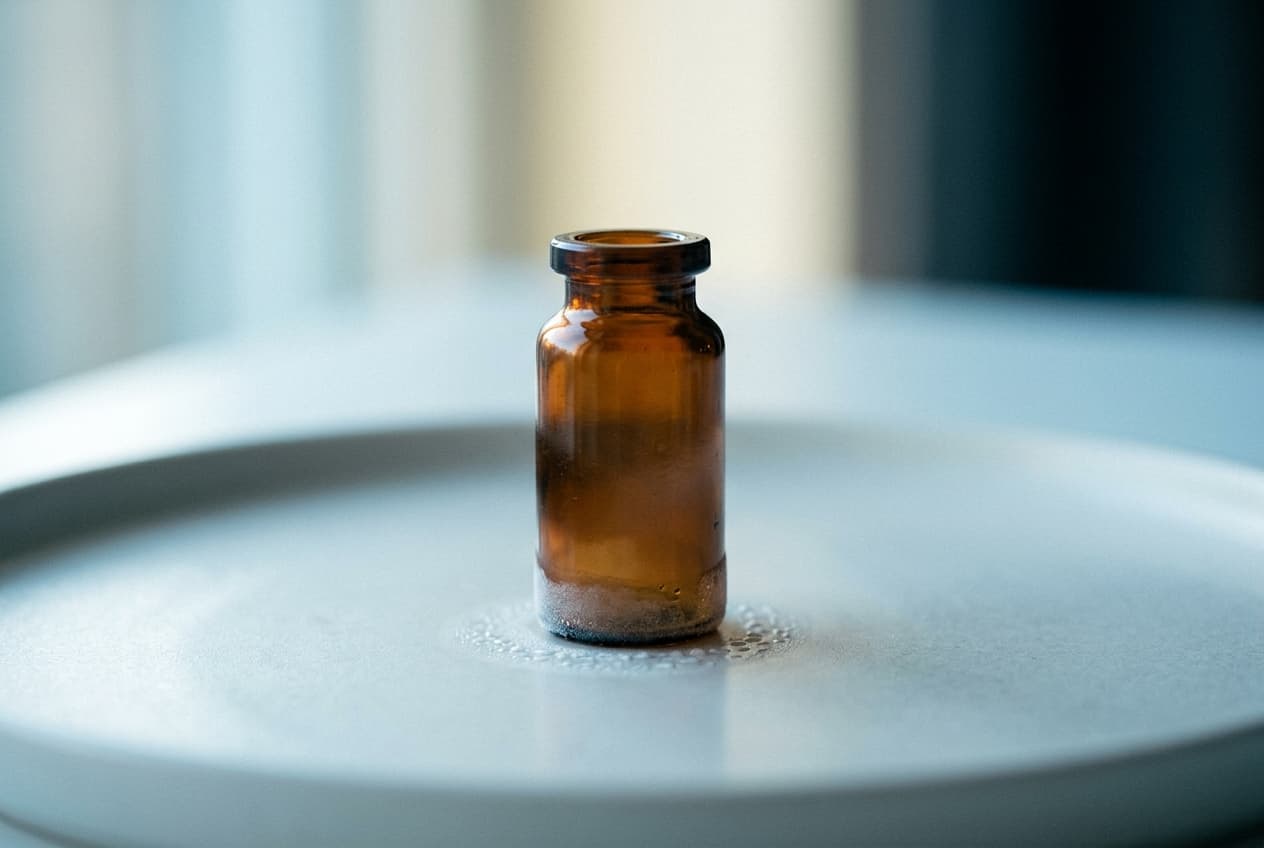
Refrigerate at 2 to 8 °C immediately after reconstitution. Do not freeze. Light-protected. Sermorelin is the least stable of the GHRH analogues in solution. Fridge stability is realistically 14 days, with measurable potency loss by week 3. This is why a 4-week dosing cycle on sermorelin should match a 4-week reconstitution batch, ideally smaller. The molecule is degraded fastest by heat. Never leave the vial in a warm car.
Cost & sourcing red flags
Typical price range: Compounded sermorelin from US 503A/503B pharmacies runs $150 to 500/month via telehealth (medication, supplies, prescriber oversight), with 5 mg vials wholesaling around $140 to 200. Research-grade sermorelin sells for $30 to 60 per 5 mg vial from US-domestic suppliers, with per-mg cost roughly $6 to 12.
Red flags
- 5 mg vials under $20. Sermorelin (GRF 1-29) is a 29-amino-acid peptide and not as cheap to synthesise at GMP grade as the small pentapeptides; bargain pricing usually means lower purity or short-sequence impurities.
- Pre-mixed liquid sermorelin shipped at ambient temperature. Sermorelin in solution is notoriously unstable. Its half-life in aqueous storage is days at room temperature versus months as a lyophilised powder. Pre-mixed product is the most common way users end up dosing degraded peptide.
- Vendors who do not specify the exact GRF 1-29 sequence or who confuse sermorelin with 'modified GRF 1-29' (which is CJC-1295 no-DAC). The two are chemically distinct and pharmacokinetically different (sermorelin half-life is roughly 10 minutes; modified GRF is roughly 30 minutes).
- Compounded sermorelin packages that ship without cold-chain documentation. FDA bulk compounding rules require sermorelin to be handled cold; pharmacies that skip the gel pack are skipping a regulatory step.
- Marketing copy that promises HGH-equivalent body-composition results. Sermorelin produces a much smaller IGF-1 rise than exogenous HGH at standard 300 mcg nightly dosing; vendors leaning on physique transformations are overselling a sleep-and-recovery peptide.
Pricing rots fast and varies by region and supplier. We list no vendors.
Common mistakes
Daytime dosing.
Better approach: Sermorelin's half-life is 10 to 20 minutes. A daytime shot produces a pulse that fights ambient insulin and food signals and gets you a fraction of the effect. Pre-bed on an empty stomach is the dosing protocol the pharmacology was designed around. Anything else wastes most of the dose.
Expecting Sermorelin to act like HGH.
Better approach: This is the gentlest tool in the GH category. The timeline is months, not weeks, and the magnitude is modest. If you want a faster, bigger effect, Sermorelin is the wrong peptide. Try CJC-1295 + Ipamorelin or HGH. Sermorelin's value is its physiologic gentleness, not its punch.
Pushing doses above 300 mcg per pulse.
Better approach: The pituitary GHRH receptor saturates well before 300 mcg. Going higher does not produce a bigger pulse. The limiting step is upstream of the dose. Stack with Ipamorelin for amplification instead of escalating Sermorelin alone.
Eating dinner late and dosing right after.
Better approach: Insulin from the meal blunts the pulse. Either move dinner earlier and dose at the usual time, or delay the shot until the post-meal insulin window has closed. The 30-minute food-free rule is non-negotiable for short-half-life GHRH peptides.
Real-world tips
- Pre-bed dosing 20 to 30 minutes before lights-out lands the pulse in the natural sleep-onset GH window. That is the design.
- Track sleep depth in the first two weeks. It is the cleanest signal that the protocol is working.
- Stack with Ipamorelin for users who want more than the solo effect. The GHRH + GHRP combination roughly doubles the pulse amplitude.
- Refrigerate after reconstitution. Sermorelin is less stable at room temperature than the modified GHRH analogues. Fridge is mandatory for full potency across the dosing month.
- If sleep onset is what you are dosing for, do not also take melatonin in the same window. Two sleep-onset pulses in the same 30 minutes is not additive and the melatonin can flatten the GH effect.
What users report
Aggregated from r/Peptides, longevity forums, and telehealth clinic reviews. Not clinical data.
Onset: Users describe falling asleep faster and waking less within 7 to 14 days of consistent nightly subcutaneous injection; the broader energy, recovery, and subtle body-composition shift lands at 4 to 8 weeks.
Common reports
- Falling-asleep latency drops noticeably in the first 1 to 2 weeks, often from 20 to 30 minutes to 10 to 15 minutes. This is the most consistently reported sermorelin effect across telehealth-clinic reviews.
- Brief mild flush or warmth at the injection site lasting 5 to 10 minutes, particularly in the first 1 to 2 weeks. Resolves with continued use.
- Daytime energy improvement at the 3 to 6 week mark, described less as 'stimulation' and more as 'fewer afternoon crashes'.
- Slow recomp signal. Most users report a modest waist-circumference drop and slightly better post-exercise recovery by week 8, but no dramatic body-composition shift on solo sermorelin.
- Compliance attrition by month 3 is common; users either stay because the sleep effect is the goal, or quit because they expected HGH-grade physique results and did not get them.
Where reports diverge from theory: Sermorelin is the textbook 'physiological GHRH analog' that should produce clean pulsatile GH release. The forum reality is that the acute GH pulse from sermorelin is real but small, and the IGF-1 lift on bloodwork is modest enough that users running solo sermorelin frequently see numbers indistinguishable from baseline noise. This is the gap between the marketing pitch (telehealth clinics frame sermorelin as 'natural HGH alternative') and the bloodwork outcomes posted on Reddit. Sermorelin works for sleep and incremental recovery; it does not produce HGH-magnitude effects, and users who expected the latter are the loudest critics on forums.
When something else is the better tool
CJC-1295 (no DAC)
Use instead when: You want a fuller pulse and the same physiologic pulse pattern. CJC-1295 is essentially Sermorelin with substitutions that resist enzymatic breakdown. Same backbone, longer pulse, slightly stronger effect. For body-recomp focus, CJC-1295 is the upgrade.
Tesamorelin
Use instead when: Visceral fat is the explicit target. Tesamorelin is on-label for HIV-associated lipodystrophy and the visceral-fat trial data is much stronger than Sermorelin's body-composition evidence base.
HGH
Use instead when: You need a pharmacological effect Sermorelin cannot produce. HGH bypasses the pituitary entirely; Sermorelin asks the pituitary politely. The right tool depends on whether the pituitary still has gas in the tank. In age-related decline it usually does, and Sermorelin is the gentler choice.
Based on 1 peer-reviewed study
- Sermorelin or CJC-1295?
- Sermorelin is the original unmodified GHRH fragment. Shorter pulse, gentler effect. CJC-1295 is the stabilised version with longer half-life and fuller pulse. For minimal intervention, Sermorelin. For more body-recomp signal, CJC-1295.
- Is it good for older adults?
- Yes. Age-related GH decline is one of the cleanest indications. The pituitary still works in most healthy older adults; Sermorelin gives it the GHRH signal the hypothalamus has dialled back with age. Friendlier risk-benefit than HGH for this group.
- Why pre-bed only?
- The natural GH pulse fires shortly after sleep onset. Sermorelin's short half-life means the dose has to land in that window to do useful work. Daytime dosing fights ambient food and insulin signals and wastes most of the effect.
- How long until I feel something?
- Sleep changes within a week. Recovery in 4 to 6 weeks. Body composition shifts at 8 to 12 weeks. Sermorelin is slow. Judging it on a 4-week timeline understates what it does.
- Was Sermorelin really FDA-approved?
- Yes. For paediatric GH deficiency, from 1997 until 2008. Withdrawn for commercial reasons, not safety or efficacy. Unusual regulatory history in the secretagogue family.
Last updated:
Related peptides
Other compounds in this category
- HGH (Somatropin)Recombinant human growth hormone. The actual hormone itself, not a secretagogue. Powerful for body recomposition, with side effects that scale unmistakably with dose.
- CJC-1295 / IpamorelinThe workhorse GH-secretagogue stack: a GHRH analogue paired with a selective ghrelin agonist. GHRH plus GHRP produces more GH per pulse than either alone, with a side-effect profile most people find tolerable for indefinite use.
- IpamorelinA selective ghrelin-receptor agonist that triggers a GH pulse without raising cortisol or prolactin. The property that made it the default GHRP and pushed the older, dirtier GHRPs to the margins.
- CJC-1295 (no DAC)A short-acting GHRH analogue. The GH pulse it produces is sharp, brief, and very close to what the pituitary does on its own. Stabilised against rapid breakdown, but without the albumin-binding modification that turns it into the long-acting DAC version.
- IGF-1 LR3The growth signal one step downstream of GH, with an extended half-life and a real hypoglycaemia risk. The most directly anabolic peptide a non-medical user can buy, and the one with the most teeth.
Head-to-head
Direct comparisons with similar peptides