

KPV
Also known as: Lysine-Proline-Valine
The three-amino-acid tail of α-MSH. Anti-inflammatory in test tubes and animals; some small IBD signal in humans.
Overview
KPV is the C-terminal tripeptide of α-melanocyte stimulating hormone. Lysine, proline, valine. It carries the anti-inflammatory activity of the parent hormone without the pigmentation or appetite effects, which makes it interesting as a clean inflammation tool. KPV blunts NF-κB signalling, reduces pro-inflammatory cytokines, and has shown protective effects in animal models of colitis, dermatitis, and topical wound inflammation. The human evidence is thinner: a few small open-label trials in inflammatory bowel disease show benefit; the rest of the claims (gut healing, skin inflammation, joint discomfort) live on cell-culture studies and user reports. Well-tolerated and probably better as a targeted anti-inflammatory adjunct than as monotherapy for anything serious.[1]
Evidence quality
Animal data is consistent across colitis, dermatitis, and wound-inflammation models. The human evidence base is small open-label IBD work, plus some topical dermatology studies. There are no completed RCTs at a regulatory scale. Treat the gut and skin anti-inflammatory claims as cautiously supported and the others as still speculative.
Benefits & timeline
Benefits
- Reduces gut inflammation in animal colitis models and small human IBD trials. The strongest part of the file
- Useful adjunct for inflammatory skin conditions (eczema, psoriasis) in topical formulations
- Generally well-tolerated, with a clean side-effect profile
- Compact tripeptide. Survives oral dosing better than larger peptides, which makes the oral route genuinely useful for gut targets
Timeline
Week 1
Inflammatory symptoms may start to soften. Bowel urgency, skin redness, joint stiffness.
Week 2 to 4
Most users have a sense of whether they're responding by here.
Week 6 to 8
Plateau of the anti-inflammatory effect; this is the window to assess and decide on continuation.
Off-cycle
2 to 4 weeks off to confirm the gains hold and the inflammation hasn't simply been suppressed without being resolved.
Dosage protocols
Advanced
1 mg
twice daily
Beginner
250 mcg
once daily
Standard
500 mcg
twice daily
Titration & adjustment
Start at 250 mcg subcutaneously once daily. After 1 week escalate to 500 mcg twice daily for inflammatory flares. Maximum 1 mg twice daily. For gut issues, oral capsules at the same total daily dose are equally effective.
Injection timing

Subcutaneous, 1 to 2× daily. Time of day does not matter. For oral capsules (gut use), take with meals to spread the local effect across the day.
Side effects & contraindications

- mildInjection-site flushing or mild irritation.
- mildHeadache in the first few days, usually fades.
- mildTransient GI symptoms with oral capsules in some users.
- moderateLimited long-term human safety data; the molecule is small and natural-ish, but 'small and natural-ish' isn't the same as 'characterised at the doses people are using'.
Contraindications
- Pregnancy. No human safety data
- Severe immunosuppression. Damping inflammation further is the wrong direction
- Active infection that needs the inflammatory response to clear
- Caution with concurrent biologic immunomodulators; the mechanisms overlap and the combined effect hasn't been studied
Reconstitution & injection
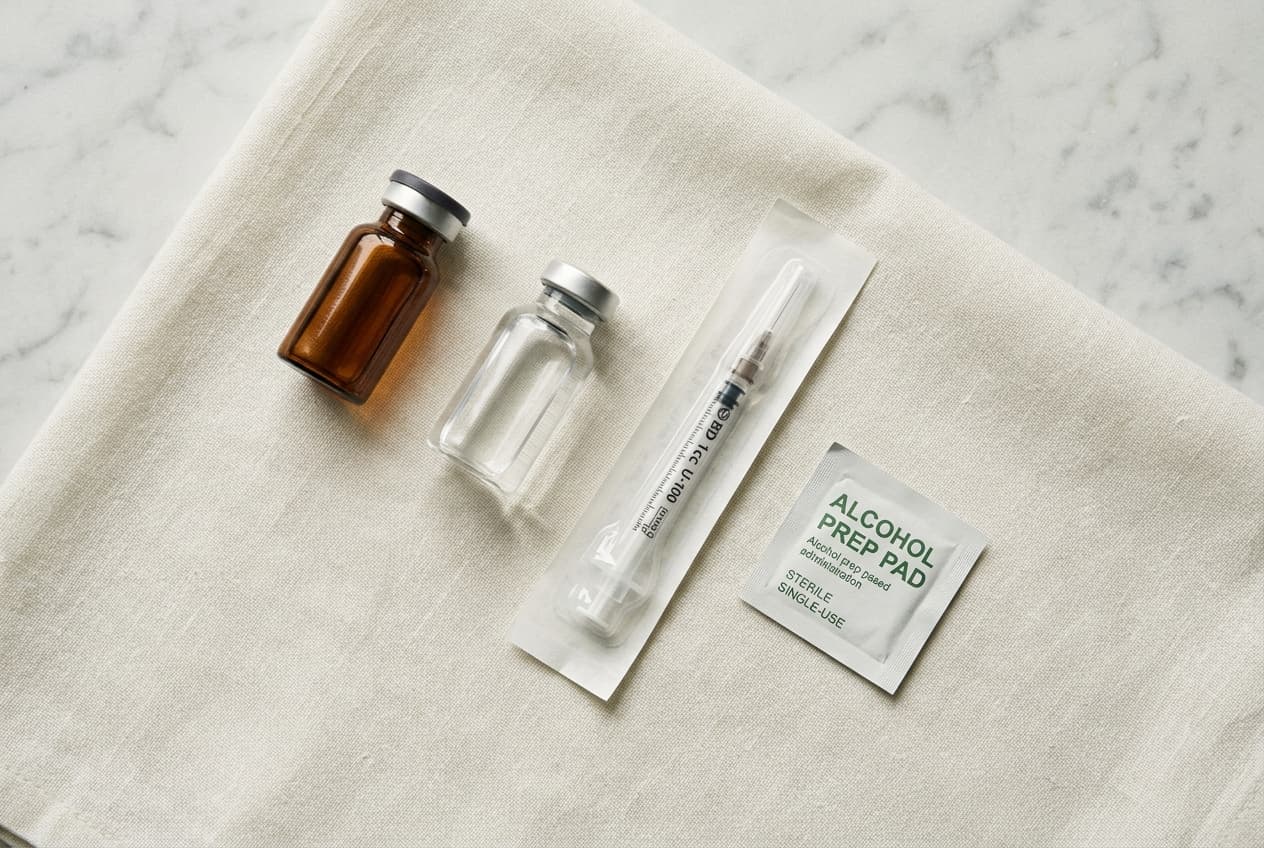
A 10 mg vial reconstituted with 2 ml bacteriostatic water gives 5 mg/ml. A 500 mcg dose is 0.1 ml, which is 10 units on a U-100 insulin syringe. Subcutaneous in the abdomen, one to two times daily. Oral capsules at the same total daily dose are equally reasonable for gut-targeted use because KPV resists peptidase breakdown better than larger peptides. For skin, topical formulations at 0.05 to 0.1% in a clean carrier work for inflammatory lesions.
Open calculator pre-filledStorage after reconstitution
Refrigerate at 2 to 8 °C after reconstitution. Do not freeze. Light-protected. 28 to 30 days of stability at fridge temperature in BAC water. Oral capsules (for gut-targeted use). Room temperature, sealed bottle with desiccant, no fridge needed.
Cost & sourcing red flags
Typical price range: Research-grade injectable KPV: $35 to 70 per 10 mg vial. Oral capsules (compounded with enteric coating): $50 to 100 per 60-count bottle of 500 mcg capsules. Topical KPV cream from compounding pharmacies: $40 to 80 per 30 g tube. A 4-week oral cycle costs $30 to 60 in raw material.
Red flags
- Oral KPV sold as plain gelatin capsules with no enteric coating. KPV is a tripeptide and is digested by gastric proteases within minutes of hitting stomach acid; without enteric protection or DR (delayed-release) formulation, oral dosing is mostly wasted.
- 5 mg or 10 mg vials priced under $15. KPV is structurally simple (three amino acids) and cheap to synthesise, so genuine product is inexpensive, but vials below this floor still tend to assay short or contain undisclosed acetate-salt fillers.
- Suppliers selling KPV alongside 'KPV-AcS' or 'KPV-amide' without specifying which one ships. The amidated and salt forms have different stabilities and slightly different activity profiles; ambiguity in the listing usually means the vendor doesn't know either.
- Topical KPV creams without disclosed pH or vehicle. KPV is unstable at extreme pH and degrades in many cosmetic bases; pharmacy compounders without a stability-tested formulation produce inconsistent product.
- Marketing that bundles KPV with 'FDA-approved' language. KPV is not approved for any indication; the FDA in fact placed it (alongside BPC-157 and ipamorelin) on the Category 2 compounding-restriction list in late 2023.
Pricing rots fast and varies by region and supplier. We list no vendors.
Common mistakes
Using it as a monotherapy for severe IBD.
Better approach: KPV is an adjunct, not a replacement for biologics or 5-ASAs in moderate-to-severe disease. Stack it with the proven therapy and use it for symptom modulation, not as the primary treatment.
Going subcutaneous for gut issues when oral would do.
Better approach: KPV is one of the rare peptides where the oral route actually works because the tripeptide is small and stable. For gut targets, oral capsules with meals are at least as effective as injection.
Running it indefinitely.
Better approach: The anti-inflammatory effect plateaus by 6 to 8 weeks. Continued daily dosing past the plateau adds little. Cycle 6 to 8 weeks on, 2 to 4 weeks off, and use the pause to assess whether the underlying inflammation has actually resolved.
Confusing it with BPC-157.
Better approach: BPC-157 is a tissue-repair peptide that also calms inflammation. KPV is an inflammation peptide that doesn't really do tissue repair. For an acute injury, BPC-157 is the better tool. For chronic inflammation without tissue damage, KPV is more targeted.
Real-world tips
- For oral gut dosing, take with food. It slows transit slightly and gives the peptide more time at the inflamed surface.
- Topical KPV in a serum base can be layered with niacinamide for inflammatory acne. Many users describe a faster lesion-resolution time.
- Track one inflammation marker if you can. Bowel frequency, joint stiffness in the morning, skin lesion count. Objective metrics outperform 'I feel better' for a peptide this subtle.
- Refrigerate reconstituted vials. The tripeptide is stable but not invincible.
- Combine with the obvious anti-inflammatory basics. Diet, sleep, weight, fish oil. KPV is unlikely to outperform fixing the lifestyle drivers of inflammation when those are off.
What users report
Aggregated from r/Peptides, r/CrohnsDisease, and IBD forum threads. Not clinical data.
Onset: Oral or subcutaneous 500 mcg twice daily: bowel-symptom improvements (stool consistency, urgency) typically land at 10 to 14 days, with skin-inflammation effects (eczema, rosacea flares) closer to 3 to 4 weeks.
Common reports
- Reduced bowel movement frequency and improved stool consistency within 2 weeks of oral dosing in active-IBD users, often the first sign the protocol is doing something.
- Visible calming of eczema, rosacea, and contact-dermatitis patches with topical application after 1 to 2 weeks of twice-daily use.
- Mild headache and transient flushing in the first 2 to 3 days of injectable dosing, fading by end of week 1.
- Subjective 'food reactivity' improvements at week 3 to 4, with users reintroducing previously avoided foods and tolerating them better. This is the most consistently reported but hardest-to-measure effect.
- Users on biologics (Humira, Stelara, Entyvio) report no felt interaction and continue both; no controlled data exists to confirm safety of co-use.
Where reports diverge from theory: KPV is the C-terminal fragment of alpha-MSH and the literature focuses on NF-kB and cytokine modulation in cell culture and animal models. Forum users routinely report systemic effects (mood lift, better energy, generalised inflammation relief) from oral or topical dosing that the pharmacokinetic data does not predict; KPV's circulating half-life is roughly 30 minutes and oral bioavailability without enteric protection is essentially nil. The gut-luminal mechanism (direct effect on enterocytes) is the most defensible explanation for the IBD reports; the systemic claims are weaker.
When something else is the better tool
BPC-157
Use instead when: Tissue damage is part of the picture. Gut lining injury from NSAIDs, mucosal damage from chronic gastritis, or a tendon problem with an inflammatory component. BPC-157 repairs the tissue; KPV just calms the inflammation around it.
Low-dose naltrexone (LDN)
Use instead when: The inflammation is autoimmune and the goal is gentle, long-term immune modulation. LDN has more clinical track record and is oral, cheap, and prescribable in most jurisdictions.
Conventional biologics or 5-ASAs
Use instead when: The diagnosis is moderate-to-severe IBD or active autoimmune disease. KPV is an adjunct, not a substitute.
Based on 1 peer-reviewed study
- Oral or injected?
- For gut targets, oral is reasonable and often easier. For systemic anti-inflammatory effect, injected. The tripeptide structure means oral isn't the dead loss it is with larger peptides.
- Does it interact with biologics?
- No formal interaction data exists. Mechanism overlap suggests caution. Talk to the prescribing physician before stacking.
- How does it compare to α-MSH itself?
- α-MSH carries the same anti-inflammatory activity plus the pigmentation and appetite effects. KPV is a clean fragment. Same anti-inflammation, none of the rest. That's the appeal.
- Can it help with eczema topically?
- Small studies and consistent anecdotal reports support topical use for eczema and inflammatory acne. Formulate at 0.05 to 0.1% in a clean carrier; apply on the affected area twice daily.
Last updated:
Related peptides
Other compounds in this category
- Thymosin Alpha-1A 28-amino-acid thymic peptide marketed as Zadaxin. Approved in over 30 countries for hepatitis B and C; used off-label for chronic infection and immune resilience.
- ThymalinA thymic peptide preparation developed in the Soviet bioregulator program. Used in Russia for decades as an immune support adjunct; Western trial data is sparse.
- LL-37The body's main cathelicidin. A broad-spectrum antimicrobial peptide. Strong in vitro, useful in topical research, almost nothing settled about systemic use.